E-mail:BD@ebraincase.com
Tel:+8618971215294
English 中文版
Pioneering Innovation in Gene Vector Research - BrainCasePioneering Innovation in Gene Vector Research - BrainCase
  • Home
  • Pre-made AAV Library
    CRISPRRNAiHSV-helperRV-helperNeurotropic virusCalcium SensorsOptogenetics activationOptogenetics inhibitionChemical geneticsSparse labelingFluorescent proteinBiosensorsRecombinaseApoptosis & AutophagyDisease ModelNeurotoxicityOther
  • Products & Service

    Product Center

    Virus

    Vesicular Stomatitis Virus-VSV
    RCAS-TVA
    Lentivirus
    Rabies Virus-RABV
    Herpes simplex virus-HSV
    Pseudorabies virus-PRV
    Adeno-Associated Virus-AAV
    Neurotropic virus list
    Baculovirus

    Kits

    EndoFree Plasmid Maxi Kit
    Lentivirus Concentration Kit

    Plasmid Construction & Vector cloning

    Lentiviral Vector
    AAV Vector
    Plasmid
    Plasmid Library

    Popular Applications

    Gene Regulation

    Gene Overexpression-Brain Case
    RNA interference(RNAi)-siRNA-Brain Case
    Gene Editing - CRSIPR cloning - BrainCase

    Neural Circuit Function Research

    Optogenetics - BrainCase
    Chemical genetics-DREADDs-Brain Case
    Calcium signal recording-Gels- Brain Case
    GRAB Neurotransmitter Fluorescent Sensor- Brain Case
    Functional Magnetic Resonance Imaging Technology- Brain Case

    Research on the structure of neural circuits

    Direct Input and Output-viral vectors- Brain Case
    Anterograde Mono-synaptic Tracing -HSV- Brain Case
    Antrograde Muti-synaptic Tracing-HSV & VSV-Brain Case
    Retrograde Mono-synaptic Tracing-Rabies Virus-Brain Case
    Retrograde Muti-synaptic Tracing-PRV-Brain Case

    Featured Services

    AAV Serotype Screening

    AAV Serotypes screening-gene therapy

    Collaboration Products

    Kiryl Piatkevich lab
    Yulong Li lab
    Zhifei Fu lab
    Woo-ping Ge lab

    Oncolytic Virus Modification

    Oncolytic virus-for cancer therapy-Brain Case
    Herpes Virus Vector-anti-tumor- BrainCase
    Vesicular stomatitis virus-killing tumor cells-Brain Case
  • News
    Corporate News New Product Launch Test Report Investor News
  • Support
    Literature interpretation Customer article FAQs Blog Legal
  • About Us
    Pre-made AAV Library Products & Service News Support About Us Contact
  • Contact
    Contact Us Join us
  • 中文
    English 中文版
  • Home
  • Support
  • Blog
  • Support
  • Literature interpretation
  • Customer article
  • FAQs
  • Blog
  • Legal

Starting from Scratch with RNA Interference: What You Need to Know

Release time:2026-04-09 16:17:54
Gene silencing is an important method for regulating gene expression in eukaryotic cells. RNA interference (RNAi) is an effective tool for this, inhibiting gene expression by blocking the transcription or translation of specific genes.


Key Points of RNAi Technology Applications:

It is crucial to use the appropriate method to deliver exogenous small interfering RNA (siRNA) into the target organism. After a series of biochemical pathways, this triggers the RNA interference effect.

Sources of siRNA

1. In vitro synthesis
siRNA fragments are synthetically made, amplified by PCR, and then introduced into target cells. Disadvantages: The effectiveness depends on the transfection efficiency of the cells, and it does not allow for long-term RNA interference.
 
Table 1: Comparison of Various In Vitro siRNA Synthesis Methods
Name Synthesis Method Applicable Not Applicable
Chemical Synthesis Direct synthesis When the most effective siRNA has already been found; need large quantities of siRNA Screening of siRNAs need long-term research
In vitro Transcription Transcription using DNA oligos as templates Screening of siRNAs; when the cost of chemical synthesis becomes a barrier Need large quantities of a specific siRNA and long-term research
RNase III Digestion RNase III digestion of long double-stranded RNA fragments Quick and cost-effective study of gene function loss phenotypes Long-term research projects; specific siRNAs (e.g., gene therapy)


2.In vivo synthesis
The required siRNA fragments are introduced into the target cells using a vector. This method overcomes the limitations of artificially synthesizing siRNA in vitro.


Designing siRNA Vectors

Plasmids are typically used as vectors to deliver siRNA into cells. The introduced vector can produce hairpin-shaped siRNA (shRNA) in vivo, similar to miRNA.
The designed vector DNA should include the following components:
1. 
Sense strand: This sequence is the same as the gene sequence required for transcribing the target mRNA in the organism.
2. 
Antisense strand: This strand is complementary to the sense strand, and its transcription yields siRNA that is complementary to the target mRNA.
3. 
Non-complementary sequence: This ensures that the vector forms a hairpin structure after transcription.
4. 
Restriction enzyme sites: Such as BamH I & Hind III for cleavage.


Designing siRNA Sequences

In addition to selecting the appropriate siRNA vector, the following points must be considered when designing siRNA sequences:
1. Design the ends to contain 5-6 A (T)
siRNA vectors are transcribed by RNA polymerase III, which can transcribe most small RNA segments in mammals. A characteristic of RNA polymerase III is that transcription stops when it reaches 5-6 adenine nucleotides (A), so the transcribed siRNA vector will have 5-6 uracil (U) at the 3' end.

2. Select 2-5 different parts of the target gene sequence

Target mRNA in the organism may have certain regions bound by regulatory proteins, making RNAi less effective. Thus, it is necessary to select different gene fragments for transcription to improve the efficiency of gene expression suppression.


Principles for Selecting RNAi Target Sequences

1. Start from the AUG initiation codon of the transcript (mRNA) and look for the "AA" dinucleotide sequence. Record the 19 base sequence at its 3' end as a potential siRNA target site. Studies have shown that siRNAs with a GC content of 45%-55% are more effective than those with higher GC content.

2. Compare the potential sequences with the corresponding genome database (e.g., human, mouse, rat) to exclude sequences that are homologous to other coding sequences/ESTs.
 For example, use BLAST for experimental comparison
(https://blast.ncbi.nlm.nih.gov/Blast.cgi).

3. Select appropriate target sequences for synthesis. Typically, multiple target siRNA sequences are designed for a gene to identify the most effective siRNA.


Negative Control
A complete siRNA experiment should include a negative control. The siRNA used as a negative control should have the same composition as the selected siRNA sequence, but should not show significant homology with the target mRNA. Typically, the selected siRNA sequence is scrambled, and results should be checked to ensure that it has no homology with other genes in the target cells.

RNA Interference Efficiency Detection

Efficiency should generally be assessed at three levels: mRNA, protein, and cellular phenotype.
🔹mRNA level: Can be detected using RT-PCR or Real-time PCR.
🔹Protein level: Detection can be done via Western blot, ELISA, or immunohistochemistry.
🔹Cellular phenotype level: Can be evaluated using methods such as MTT, colony formation assays, flow cytometry, or cell chamber experiments.


Example Case

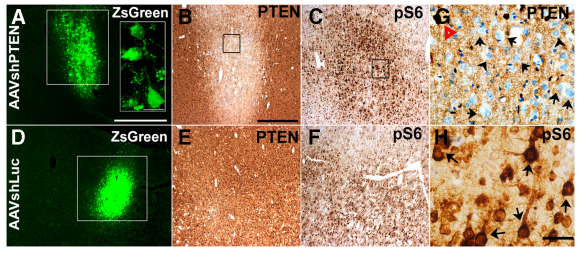
Lewandowski et al. used AAV-mediated expression of shRNA to suppress PTEN expression in adult rats, leading to increased phosphorylation of ribosomal protein pS6.

Figure 1: AAV-mediated suppression of PTEN expression in the cortex of adult rats via intraparenchymal injection. (Lewandowski, et al., Journal of Neuroscience, 2014)


BrainCase offers all the above products and services.
For any related inquiries, please Contact Us.

Service Type :

Select the service you'd like to purchase.

Order Information(Premade-AAVs)

Please provide us some information about the service you'd like to order.

How did you hear about BrainCase Biotech or our products?(Fill in this field to get a discount coupon)

Detailed requirements:

scroll

Order Information(Custom AAV/Lentivirus)

Please provide us some information about the service you'd like to order.

Gene ID or gene information:

Selection of the reporting gene:

Special Instructions:

scroll

Order Information(Others)

Please provide us some information about the service you'd like to order.

Virus name/Detailed requirements:

scroll

Related products

Starting from Scratch with RNA Interference: What You Need to Know

Starting from Scratch with RNA Interference: What You Need to Know

How to Choose the Right Optogenetic Protein for Optogenetics

How to Choose the Right Optogenetic Protein for Optogenetics

Day 2 Highlights from the 2025 Neuroscience & Cell and Gene Therapy Frontier Symposium

Day 2 Highlights from the 2025 Neuroscience & Cell and Gene Therapy Frontier Symposium

 2025 Neuroscience & Cell and Gene Therapy Frontier Symposium !

2025 Neuroscience & Cell and Gene Therapy Frontier Symposium !

map
{dede:global.cfg_webname/}

Pre-made AAV Library

CRISPR
RNAi
Neurotropic virus
Optogenetics activation
Biosensors

News

Corporate News
New Product Launch
Test Report
Investor News

Support

Literature interpretation
Customer article
FAQs
Blog
Legal
微信

WhatsApp Business Account

Tel: +8618971215294
E-mail: BD@ebraincase.com

Address:-

Address:-

  • Copyright © 2024 Brain Case All Rights Reserved.