E-mail:BD@ebraincase.com
Tel:+8618971215294
English 中文版
Pioneering Innovation in Gene Vector Research - BrainCasePioneering Innovation in Gene Vector Research - BrainCase
  • Home
  • Pre-made AAV Library
    CRISPRRNAiHSV-helperRV-helperNeurotropic virusCalcium SensorsOptogenetics activationOptogenetics inhibitionChemical geneticsSparse labelingFluorescent proteinBiosensorsRecombinaseApoptosis & AutophagyDisease ModelNeurotoxicityOther
  • Products & Service

    Product Center

    Virus

    VSV-circuit and oncolytic research
    Retrovirus-RCAS-TVA
    Lentivirus Vector-Lentivirus Production
    Rabies Virus Vector-RABV Vector
    Herpes simplex virus-Oncolytic and anterograde tracing
    PRV-retrograd multisynaptic-Peripheral
    AAV-gene therapy vectors-neuroscience
    Neurotropic virus list
    Baculovirus

    Kits

    EndoFree Plasmid Maxi Kit
    Lentivirus Concentration Kit

    Plasmid Construction & Vector cloning

    Lentiviral Vector
    AAV Vector
    Plasmid

    Popular Applications

    Gene Regulation

    Gene Overexpression-Brain Case
    RNA interference(RNAi)-siRNA-Brain Case
    Gene Editing - CRSIPR cloning - BrainCase

    Neural Circuit Function Research

    Optogenetics - BrainCase
    Chemical genetics-DREADDs-Brain Case
    Calcium signal recording-Gels- Brain Case
    GRAB Neurotransmitter Fluorescent Sensor- Brain Case
    Functional Magnetic Resonance Imaging Technology- Brain Case

    Research on the structure of neural circuits

    Direct Input and Output-viral vectors- Brain Case
    Anterograde Mono-synaptic Tracing -HSV- Brain Case
    Antrograde Muti-synaptic Tracing-HSV & VSV-Brain Case
    Retrograde Mono-synaptic Tracing-Rabies Virus-Brain Case
    Retrograde Muti-synaptic Tracing-PRV-Brain Case

    Featured Services

    AAV Serotype Screening

    AAV Serotypes screening-gene therapy

    Collaboration Products

    Kiryl Piatkevich lab
    Yulong Li lab
    Zhifei Fu lab
    Woo-ping Ge lab

    Oncolytic Virus Modification

    Oncolytic virus-for cancer therapy-Brain Case
    Herpes Virus Vector-anti-tumor- BrainCase
    Vesicular stomatitis virus-killing tumor cells-Brain Case
  • News
    Corporate News New Product Launch Investor News
  • Support
    Literature interpretation Customer article Video Zone FAQs
  • About Us
    Pre-made AAV Library Products & Service News Support About Us Contact
  • Contact
    Contact Us Join us Team
  • 中文
    English 中文版
  • Home
  • Support
  • Literature interpretation
  • Support
  • Literature interpretation
  • Customer article
  • Video Zone
  • FAQs

Lentivirus (LV) In Vitro Infection Cell Experiment Guide: Procedures, Precautions, and Troubleshooting Tips

Release time:2026-03-13 16:28:17
Lentivirus-based in vitro cell infection is a core experimental method for constructing stable cell lines and gene function validation. With its ability to stably integrate target genes and adapt to primary cells, stem cells, and other hard-to-transfect cells, it has become an essential skill for researchers. However, challenges such as low transduction efficiency, high cytotoxicity, and selection failure often arise during the infection process. This comprehensive guide, focusing on in vitro infection, precisely addresses these core issues to help you complete the experiment efficiently!
 

1. Core Process: Standardized Steps for Lentivirus In Vitro Infection Cell

Step 1: Pre-infection Preparation (Cells + Virus)

🔹Target Cell Preparation:
Select target cells in the logarithmic growth phase (optimal condition, highest transduction efficiency) and seed them into suitable culture containers (6-well plates/12-well plates, as required). Control the seeding density to ensure the cells reach 40%-60% confluency at the time of infection (too high a density may cause competition for nutrients, while too low a density may affect infection efficiency). Culture cells overnight in antibiotic-free complete medium and observe their condition the next day (only proceed if there is no contamination and cells are highly viable).
🔹
Lentivirus Preparation:
Confirm the lentivirus titer in advance (≥10⁶ TU/mL). Retrieve the virus from the -80°C freezer and thaw it quickly on ice to avoid repeated freezing and thawing (each freeze-thaw cycle reduces the titer by approximately 30%). After thawing, gently mix the virus, then centrifuge at 4°C, 1000 rpm for 5 minutes to remove any potential cell debris, and set aside for use.

🔹Reagent Preparation:
Prepare Polybrene (polybrene), which is used to promote the binding of virus particles to the cell surface, improving transduction efficiency. The typical final concentration is 2-8 μg/mL (the optimal concentration can be determined based on related literature or pre-experiments). Also, prepare selection drugs (e.g., puromycin, hygromycin) and conduct a pre-experiment to determine the minimum toxic concentration (MTC) of the drug for target cells.

Step 2: In Vitro Infection Operation (Core Steps)

🔹Remove the original culture medium from the target cells and add fresh medium (volume adjusted according to the culture container, approximately 1.5 mL per well for a 6-well plate), simultaneously adding the prepared lentivirus solution. Adjust the MOI (multiplicity of infection, MOI = (virus titer × virus volume) / cell number) based on the target cell sensitivity. For regular cells, MOI = 5-50, while for hard-to-transfect cells (such as stem cells or primary cells), MOI can be increased to 50-100 (pre-experiments should be conducted to determine the appropriate MOI and avoid cell damage).

🔹Add Polybrene, gently shake the culture container to ensure the virus solution is evenly mixed with the medium, and incubate in a 37°C, 5% CO₂ incubator.

🔹12-24 hours after infection, observe the cell condition (if there is obvious toxicity, such as shrinkage or floating cells, the medium should be replaced in advance). Under normal conditions, replace with fresh complete medium, remove any residual virus solution and Polybrene to reduce cell toxicity, and continue culturing for 48-72 hours.

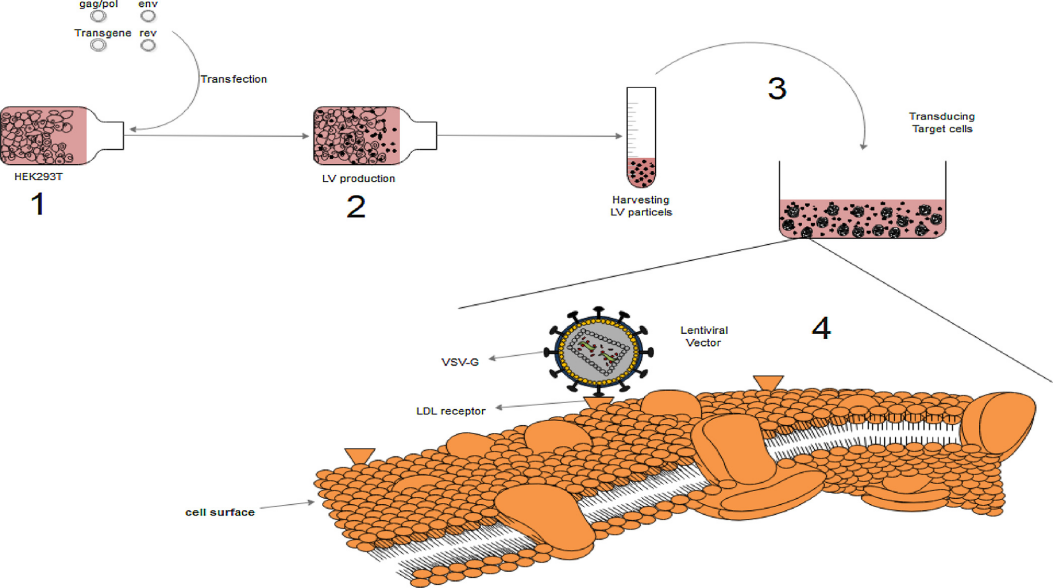
Figure 1: Schematic of Lentivirus Vector Production and Target Cell Transduction


Step 3: Selection and Verification (Essential for Constructing Stable Cell Lines)

🔹Fluorescence Observation:
48-72 hours after infection, observe the proportion of fluorescence-positive cells using a fluorescence microscope to preliminarily judge the infection efficiency (≥70% positive cells is ideal).

🔹Drug Selection:
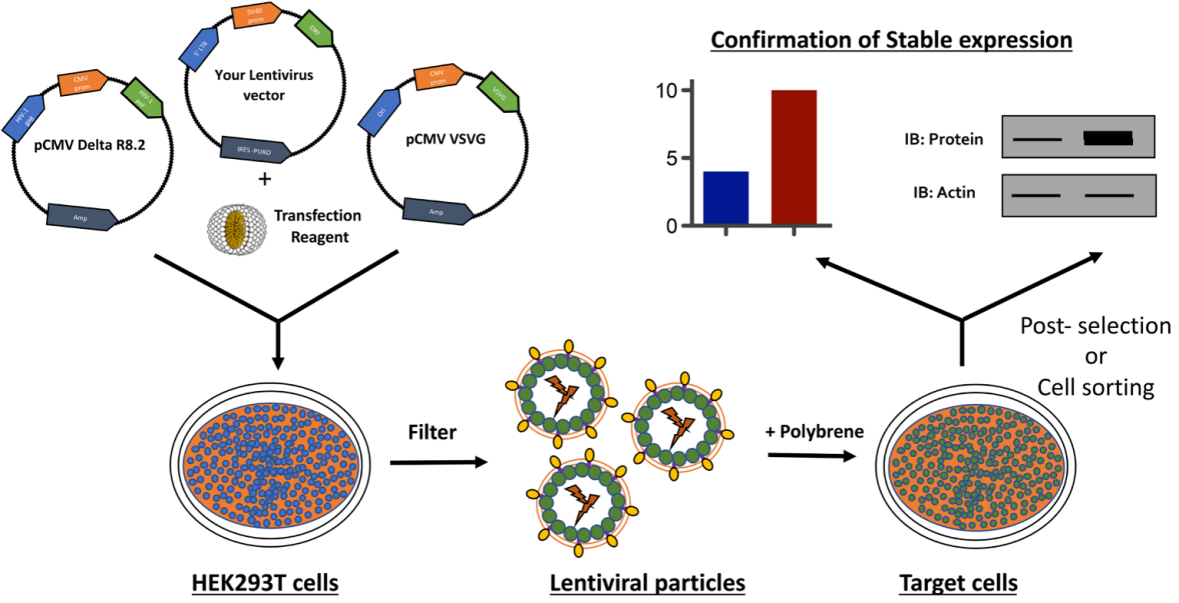
If constructing a stable cell line, add the corresponding selection drug (e.g., puromycin 2-5 μg/mL) to the culture medium according to the MTC value determined in the pre-experiment. Change the drug-containing medium every 2-3 days and continue selection for 7-14 days until all cells in the blank control group die, while the experimental group cells grow normally.

🔹Clonal Culture (Optional):
To obtain a homozygous stable cell line, use the limiting dilution method to seed the selected cells into a 96-well plate. After single-clone culture, select clones with uniform fluorescence and good growth conditions for further expansion.

🔹Expression Verification:
Use qPCR (to detect gene transcription levels), Western Blot (to detect protein expression levels), or flow cytometry to verify stable expression of the target gene. Once the cell line is confirmed to be qualified, store in liquid nitrogen for backup.

Figure 2: Schematic of Constructing Stable Cell Lines Using Lentivirus
 

II. Exclusive Precautions for In Vitro Infection: Key Pitfalls to Avoid
🔹Cell Status Control:
 Only use target cells in the logarithmic growth phase and free from contamination for infection. Senescent, apoptotic, or contaminated cells will significantly reduce transduction efficiency. Prior to infection, cell viability can be assessed using Trypan Blue staining.


🔹MOI Optimization:
Different cells show significant variability in their sensitivity to lentivirus. For the first experiment, set up a gradient of MOI values (e.g., 5, 10, 20, 50) to identify the optimal MOI, balancing both infection efficiency and cell toxicity.


🔹Polybrene Usage Cautions:
Some cells (e.g., neurons, stem cells) are sensitive to Polybrene and may experience cytotoxicity. For these cells, Polybrene should either be omitted or used at a low concentration (2-4 μg/mL) with shortened incubation times.


🔹Aseptic and Antibiotic Usage:
Strict aseptic techniques should be followed throughout the experiment. Use antibiotic-free culture medium the day before and during the infection stage. Antibiotics may interfere with the virus binding to the cell surface receptors, alter membrane permeability, induce cell stress responses affecting cell viability, or even create potential antagonistic effects with reagents like Polybrene, thus lowering transduction efficiency. If contamination is a concern, antibiotics can be added during the selection phase.


🔹Virus Usage Guidelines:
After thawing, lentivirus should be stored on ice, avoiding exposure to room temperature for extended periods (more than 1 hour can lead to reduced virus activity). Any remaining virus solution should be aliquoted and stored at -80°C, avoiding repeated freeze-thaw cycles.
 

III. Common Problems and Solutions for In Vitro Infection: Quick Troubleshooting

Common Problem Possible Causes Solutions
Low Fluorescence Positive Rate (<30%) 1. MOI too low;
2. Poor cell condition;
3. Insufficient virus activity;
4. Polybrene not added
1. Increase MOI (do not exceed 100, with pre-experiment for toxicity);
2. Replace with target cells in logarithmic growth phase;
3. Use freshly thawed virus, concentrate if necessary;
4. Add 6-8 μg/mL Polybrene or use centrifugation method.
Massive cell death following infection (high toxicity) 1. MOI too high;
2. Polybrene concentration too high;
3. Residual virus toxicity;
4. Cells are sensitive to the virus.
1. Lower MOI, perform two rounds of infection (24 hours apart);
2. Reduce Polybrene concentration or omit it;
3. Replace the medium within 12 hours after infection;
4. Conduct a pre-experiment for virus toxicity to select the tolerated concentration.
No Surviving Cells After Selection or Slow Cell Growth 1. Selection drug concentration too high;
2. Low infection efficiency, cells did not integrate the target gene;
3. Insufficient nutrients in the medium.
1. Repeat the drug toxicity pre-experiment, reduce the selection drug concentration (set to 80% of MTC);
2. Optimize infection conditions to improve the positive rate, extend the pre-selection culture time;
3. Replace with fresh complete medium, add serum or growth factors.
Unstable Expression of Stable Cell Lines, Weak Fluorescence After Passage 1. Incomplete selection, presence of mixed cells;
2. Poor integration site for the target gene;
3. Over-passage, cell aging.
1. Use limiting dilution for clonal culture, purify the cell line;
2. Change lentivirus vector, optimize target gene sequence;
3. Passage stable cell lines no more than 20 generations, store in liquid nitrogen in time.
Bacterial/Fungal Contamination During Infection 1. Non-sterile operation;
2. Virus solution or medium contamination;
3. Cells carrying bacteria.
1. Terminate infection, thoroughly disinfect the experiment environment and equipment;
2. Replace with fresh culture medium and virus solution, trace the contamination source;
3. Discard contaminated cells, re-establish the experiment with bacteria-free cells.
No Difference in WB/qPCR Quantitative Detection (Overexpression/Knockdown Failure) 1. Low infection efficiency, insufficient positive cell ratio;
2. Vector defects (gene cloning errors, incompatible promoters);
3. Improper timing of detection (expression/knockdown peak not reached);
4. Ineffective knockdown target or compensatory mechanisms;
5. Defective detection methods (poor primers/primary antibody, sample degradation).
1. Verify fluorescence positive rate, re-optimize infection conditions if <50%;
2. Verify vector validity, change to compatible promoter or redesign shRNA target;
3. For overexpression, test qPCR 48-72 hours, WB 72-96 hours; for knockdown, test at 72-96 hours;
4. Design 3-4 shRNA targets to avoid compensation;
5. Optimize primers/primary antibodies, ensure no sample degradation, include positive control.

IV. Conclusion: Core Logic of Efficient and Successful In Vitro Infection

The core of lentiviral infection in cells is "precise control of details": high-quality target cells and highly active virus are the foundation, the optimized MOI value and Polybrene usage are key, and standardized screening and validation are essential for success. By avoiding pitfalls such as toxicity, contamination, and unstable expression, and following standardized protocols, one can efficiently obtain qualified infected cells or stable cell lines, paving the way for subsequent gene function studies and organoid regulation experiments.

Service Type :

Select the service you'd like to purchase.

Order Information(Premade-AAVs)

Please provide us some information about the service you'd like to order.

How did you hear about BrainCase Biotech or our products?(Fill in this field to get a discount coupon)

Detailed requirements:

scroll

Order Information(Custom AAV/Lentivirus)

Please provide us some information about the service you'd like to order.

Gene ID or gene information:

Selection of the reporting gene:

Special Instructions:

scroll

Order Information(Others)

Please provide us some information about the service you'd like to order.

Virus name/Detailed requirements:

scroll

Related products

Lentivirus (LV) In Vitro Infection Cell Experiment Guide: Procedures, Precautions, and Troubleshooting Tips

Lentivirus (LV) In Vitro Infection Cell Experiment Guide: Procedures, Precautions, and Troubleshooting Tips

Experimental Tips: Rabies virus (RV) Retrograde Trans-Synaptic Labeling System User Guide

Experimental Tips: Rabies virus (RV) Retrograde Trans-Synaptic Labeling System User Guide

Experimental Tips | Understand Chemogenetics in 3 Minutes, Precisely Control Neuron "Switches"

Experimental Tips | Understand Chemogenetics in 3 Minutes, Precisely Control Neuron "Switches"

The Most Comprehensive Collection of Gene Delivery Tools for Brain Endothelial Cells

The Most Comprehensive Collection of Gene Delivery Tools for Brain Endothelial Cells

map
{dede:global.cfg_webname/}

Pre-made AAV Library

CRISPR
RNAi
Neurotropic virus
Optogenetics activation
Biosensors

News

Corporate News
New Product Launch
Investor News

Support

Literature interpretation
Customer article
Video Zone
FAQs
微信

WhatsApp Business Account

Tel: +8618971215294
E-mail: BD@ebraincase.com

Address:-

Address:-

  • Copyright © 2024 Brain Case All Rights Reserved.