E-mail:BD@ebraincase.com
Tel:+8618971215294
English 中文版
Virus Vector - Viral Vector Production - BrainCaseVirus Vector - Viral Vector Production - BrainCase
  • Home
  • Virus product library
    CRISPRRNAiHSV-helperRV-helperNeurophilic virusCalcium SensorsOptogenetics activationOptogenetics inhibitionChemical geneticsSparse labelingFluorescent proteinBiosensorsRecombinaseApoptosis & AutophagyDisease ModelNeurotoxicityOther
  • Products & Service

    Product Center

    Virus

    VSV-vaccine and gene therapy research
    Retrovirus-RCAS-TVA
    Lentivirus Vector-Lentivirus Production
    Rabies Virus Vector-RBV Vector
    Herpes simplex virus-Oncolytic and anterograde tracing
    PRV-retrograd multisynaptic-Peripheral
    AAV-gene therapy vectors-neuroscience

    Animal Model

    Neurological Disease Models
    Tumor animal models-anti-tumor
    Digestive System Disease Animal Model
    Cardiovascular System Disease Animal Models

    Plasmid Construction

    Library Construction
    Plasmid design and construction

    Popular Applications

    Gene Regulation

    Gene Overexpression-Brain Case
    RNA interference(RNAi)-siRNA-Brain Case
    Gene Editing - CRSIPR cloning - BrainCase

    Neural Circuit Function Research

    Optogenetics - BrainCase
    Chemical genetics-DREADDs-Brain Case
    Calcium signal recording-Gels- Brain Case
    GRAB Neurotransmitter Fluorescent Sensor- Brain Case
    Functional Magnetic Resonance Imaging Technology- Brain Case

    Research on the structure of neural circuits

    Direct Input and Output-viral vectors- Brain Case
    Anterograde Mono-synaptic Tracing -HSV- Brain Case
    Antrograde Muti-synaptic Tracing-HSV & VSV-Brain Case
    Retrograde Mono-synaptic Tracing-Rabies Virus-Brain Case
    Retrograde Muti-synaptic Tracing-PRV-Brain Case

    Featured Services

    Nervous System Disease Drug Effect

    Alzheimer's disease-AD
    Depression-mental disorders
    Parkinson's disease--PD
    Epilepsy-an ancient neurological disorder

    AAV Serotype Screening

    AAV Serotypes screening-gene therapy

    Collaboration Products

    Kiryl Piatkevich lab
    Yulong Li lab
    Zhifei Fu lab
    Woo-ping Ge lab

    Efficacy of Oncolytic Virus

    Oncolytic virus-for cancer therapy-Brain Case
    Herpes Virus Vector-anti-tumor- BrainCase
    Vesicular stomatitis virus-killing tumor cells-Brain Case
  • News
    Corporate News New Product Launch Team Investor News
  • Support
    Literature interpretation Customer article Video Zone FAQs
  • About Us
    Virus product library Products & Service News Support About Us Contact
  • Contact
    Contact Us Join us
  • 中文
    English 中文版
  • Home
  • Support
  • Literature interpretation
  • Support
  • Literature interpretation
  • Customer article
  • Video Zone
  • FAQs

Experimental Tips: Rabies virus (RV) Retrograde Trans-Synaptic Labeling System User Guide

Release time:2026-03-06 14:46:33
Rabies virus (RV), belonging to the Lyssavirus genus of the Rhabdoviridae family, has a bullet-shaped, enveloped structure with a helical nucleocapsid containing a negative-sense single-stranded RNA that encodes five viral proteins. Among these, the G protein is closely related to the virus's infection and transmission. Without the G protein, RV cannot form infectious viral particles, nor can it infect or spread. Wild-type RV has the unique characteristic of retrograde trans-synaptic spread, making it valuable for neuroanatomical studies in primates and rodents [1]. As a viral tracer tool, RV has distinctive advantages: in addition to its specific trans-synaptic transmission, RV primarily labels neurons after infecting the central nervous system, with almost no labeling of glial cells. It does not infect axons without synaptic connections, has low toxicity, and infected neurons generally do not show significant damage or lysis [2].

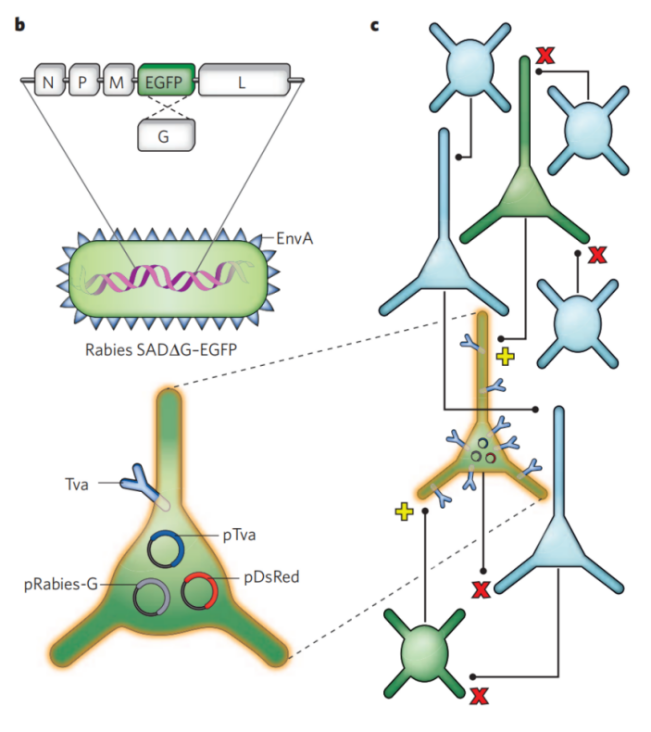
Wickersham et al. [3/4] developed a recombinant rabies virus based on the RV vaccine strain Sad B-19 with a knockout of the G protein gene and carrying fluorescent protein genes such as GFP or mCherry. Combined with the EnvA/TVA system, this allows for cell-specific initiation of infection. Since the receptor protein TVA recognized by EnvA is only present on the surface of avian cells, recombinant viral particles packaged with the RV membrane protein cannot directly infect mammals. However, if AAV, lentivirus, or retrovirus is used to express TVA on mammalian cell membranes, this RV can specifically recognize and infect neurons expressing TVA. Due to the absence of the G protein (RV-G), after entering neurons, the virus can replicate and express foreign genes but cannot package mature viral particles to infect the next-level neurons. If RV-G is externally supplied to these neurons, mature pseudovirus particles can be produced, enabling trans-synaptic infection of the upstream neurons. Upon entering the upstream neurons, RV-G-deficient viruses can replicate and express foreign genes but cannot continue trans-synaptic infection. This process allows RV to specifically trace the input networks of particular types of neurons through retrograde single-synaptic labeling.

With the maturation of reverse genetics techniques, the currently constructed replication-defective RV has lower toxicity and higher safety, making it widely used in neural circuit research. It is commonly combined with methods like electrophysiology, optogenetics, and chemogenetics to analyze the functional combinations of neural circuits and explore their working principles under both physiological and pathological conditions.

Figure 1: RV-mediated retrograde trans-synaptic labeling
 
Although the application of the RV retrograde trans-synaptic system in neural circuit research is gradually being promoted and the experimental techniques are becoming increasingly mature, there are still many important considerations for beginners. Below, we share some usage tips based on our company's RV retrograde trans-synaptic system injection test results for central nervous system labeling.
 

Example 1

AAV auxiliary virus: rAAV-EF1α-DIO-EGFP-T2A-TVA, rAAV-EF1α-DIO-N2cG
RV virus: CVS-EnvA-ΔG-tdTomato
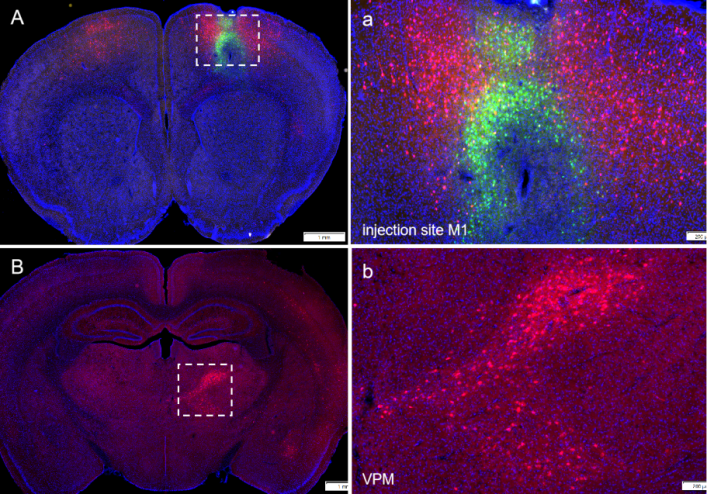
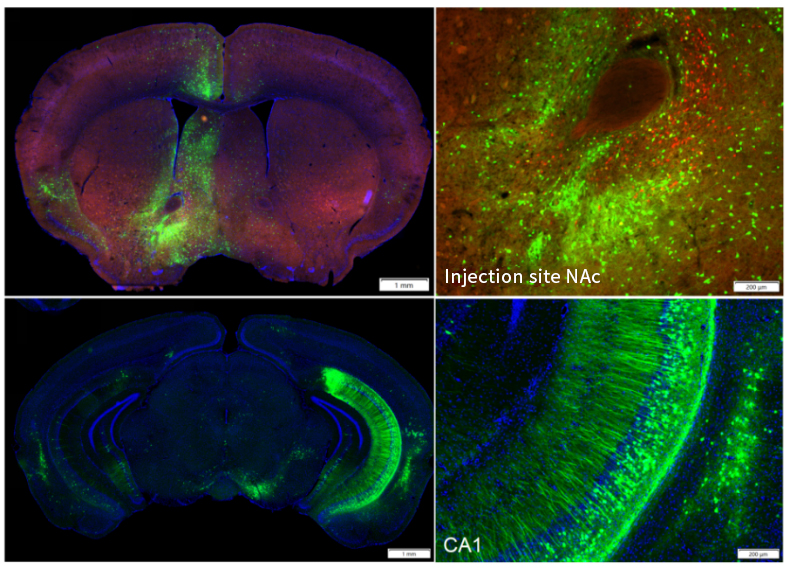
 

Example 2

AAV auxiliary virus: RMT-mCherry-1/5-N2c
RV virus: CVS-EnvA-ΔG-EGFP
 

Notes:

1. Under typical conditions, the auxiliary virus is mixed at a 1:2 (TVA:G) or 1:2:1 (TVA:G:Cre) ratio, with an injection volume of 200-250 nl. For small nuclei like the NAc, inject about 100 nl.
 
2. Inject the RV virus 14 days after AAV auxiliary virus expression, with an injection volume of 100-200 nl. After 7 days of RV expression, perform perfusion and tissue collection.
 
3. Previous studies have reported that high doses of TVA can lead to severe inflammatory responses at the injection site, making cell morphology unclear and affecting trans-synaptic efficiency. Based on test results and customer feedback, it is concluded that the TVA titer should not exceed 2x10¹² vg/mL.

4. When using Cre transgenic mice to induce AAV auxiliary virus expression, adjust the AAV injection volume based on the number of Cre-positive neurons at the injection site. The amount of auxiliary virus expression is related to the number of Cre-positive cells.

5. Regardless of the injection protocol, pilot experiments are crucial.
 

RV-Related Products and Services

Product Number Product Name Titer Remarks
——
rAAV-Promoter-DIO-EGFP-T2A-TVA 2.00E+12 VG/mL Choose one
of two options

rAAV-Promoter-DIO-mCherry-F2A-TVA 2.00E+12 VG/mL
—— rAAV-Promoter-DIO-N2cG 5.00E+12 VG/mL Required
BC-RV-CVS EnvA462 CVS-EnvA-ΔG-tdTomato 2.00E+08 IFU/mL Choose one
of four options
(With a different
fluorescence
color from TVA)
BC-RV-CVS EnvA461 CVS-EnvA-ΔG-EGFP 2.00E+08 IFU/mL
BC-RV-EnvA844 RV-EnvA-ΔG-mCherry 2.00E+08 IFU/mL
BC-RV-EnvA862 RV-EnvA-ΔG-EGFP 2.00E+08 IFU/mL

References
  1. Moschovakis AK, Gregoriou GG, Ugolini G, et al. Oculomotor areas of the primate frontal lobes: a transneuronal transfer of rabies virus and [14C]-2-deoxyglucose functional imaging study. J Neurosci. 2004;24(25):5726-5740.
  2. Kelly RM, Strick PL. Rabies as a transneuronal tracer of circuits in the central nervous system. J Neurosci Methods. 2000;103(1):63-71.
  3. Wickersham IR, Finke S, Conzelmann KK, Callaway EM. Retrograde neuronal tracing with a deletion-mutant rabies virus. Nat Methods. 2007;4(1):47-49. 
  4. Arenkiel BR, Ehlers MD. Molecular genetics and imaging technologies for circuit-based neuroanatomy. Nature. 2009;461(7266):900-907. 
  5. Reardon TR, Murray AJ, Turi GF, et al. Rabies Virus CVS-N2c(ΔG) Strain Enhances Retrograde Synaptic Transfer and Neuronal Viability. Neuron. 2016;89(4):711-724.

Service Type :

Select the service you'd like to purchase.

Order Information(Premade-AAVs)

Please provide us some information about the service you'd like to order.

How did you hear about BrainCase Biotech or our products?(Fill in this field to get a discount coupon)

Detailed requirements:

scroll

Order Information(Custom AAV/Lentivirus)

Please provide us some information about the service you'd like to order.

Gene ID or gene information:

Selection of the reporting gene:

Special Instructions:

scroll

Order Information(Others)

Please provide us some information about the service you'd like to order.

Virus name/Detailed requirements:

scroll

Related products

Experimental Tips: Rabies virus (RV) Retrograde Trans-Synaptic Labeling System User Guide

Experimental Tips: Rabies virus (RV) Retrograde Trans-Synaptic Labeling System User Guide

Experimental Tips | Understand Chemogenetics in 3 Minutes, Precisely Control Neuron "Switches"

Experimental Tips | Understand Chemogenetics in 3 Minutes, Precisely Control Neuron "Switches"

The Most Comprehensive Collection of Gene Delivery Tools for Brain Endothelial Cells

The Most Comprehensive Collection of Gene Delivery Tools for Brain Endothelial Cells

AAV vs. Lentivirus: Key Differences and Applications of  Two Masterpieces in Gene Delivery

AAV vs. Lentivirus: Key Differences and Applications of Two Masterpieces in Gene Delivery

map
{dede:global.cfg_webname/}

Virus product library

CRISPR
RNAi
Neurophilic virus
Optogenetics activation
Biosensors

News

Corporate News
New Product Launch
Team
Investor News

Support

Literature interpretation
Customer article
Video Zone
FAQs
微信

WhatsApp Business Account

Tel: +8618971215294
E-mail: BD@ebraincase.com

Address:-

Address:-

  • Copyright © 2024 Brain Case All Rights Reserved.