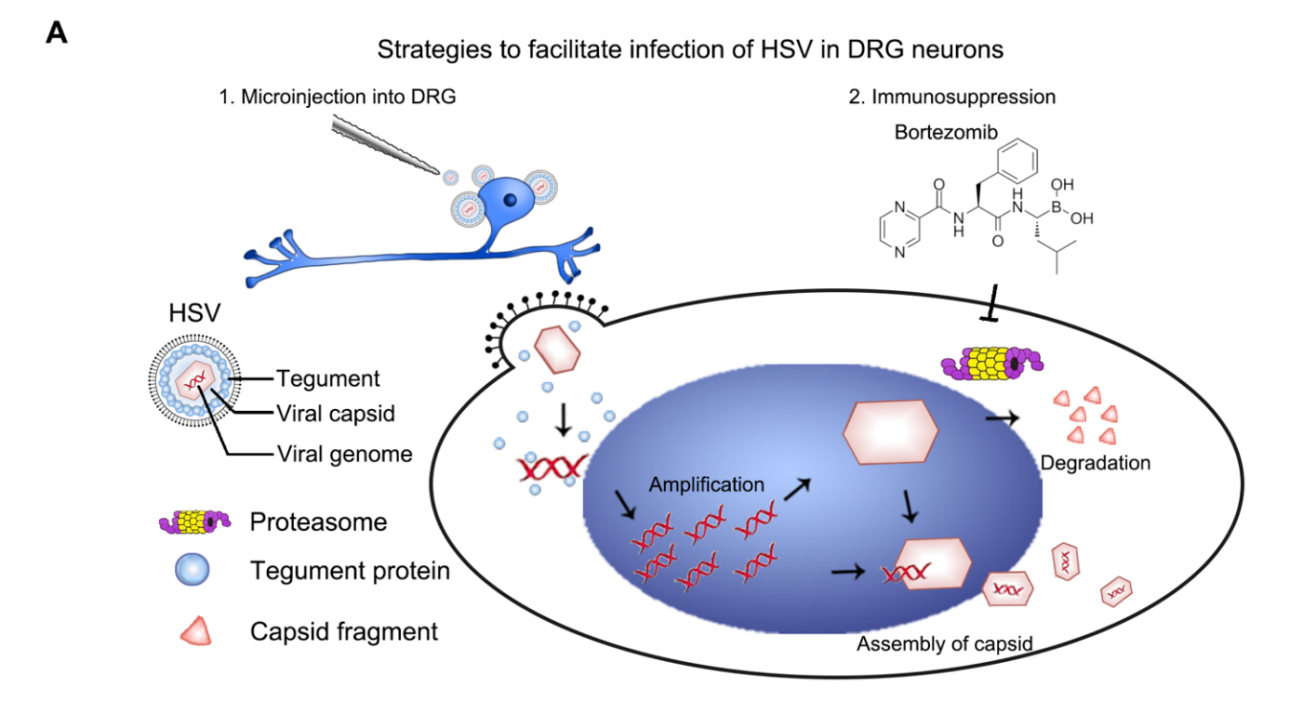
Currently, pseudorabies virus (PRV) and herpes simplex virus type 1 (HSV-1), both from the α-herpesvirus family, are commonly used for neural network tracing. These are enveloped spherical double-stranded DNA viruses with a diameter of approximately 200–250 nm. Their genome size is about 150 kb, encoding approximately 70 genes.
The most commonly used virus for anterograde transsynaptic applications is HSV-1 strain H129, which exhibits anterograde transsynaptic propagation characteristics consistent with the direction of neural impulse transmission. It is ideal for tracing studies of neural output circuits and is often used as a tracer for anterograde trans-multisynaptic neural circuits.
Advantages of HSV Viral Vectors:
🔹1. The genomic sequence and genetic background are well understood, making it easy to perform molecular genetic modifications. 🔹2. Nearly half of its genes are non-essential, and its external gene capacity is up to 40 kb, allowing it to carry complex regulatory elements and various exogenous genes. 🔹3. It has a wide host range and can effectively infect multiple species, including zebrafish, rodents, and non-human primates. 🔹4. It has high replication efficiency in the host, enabling rapid and high-intensity labeling.
Limitations of HSV Viral Vectors:
🔹1. Cytotoxicity: The virus induces immune responses in the host after infection, leading to changes in neuronal morphology, pathological lesions, death, and brain inflammation at the infection sites. Infected animals typically die during the late stages of infection. 🔹2. Variability in viral infection efficiency due to host immune differences.
Use of Immunosuppressants:
Bortezomib is an immunosuppressant and a proteasome inhibitor used in the treatment of multiple myeloma. Reports indicate that bortezomib can suppress viral capsid degradation by inhibiting the proteasome, thereby enhancing AAV infection in mice. Viruses whose replication and gene expression are influenced by proteasome activity, such as hepatitis B virus and herpes simplex virus, can be enhanced by proteasome inhibitors for better neuronal infection.
On August 10, 2022, the laboratories of Academician XuZhang at the Guangdong Provincial Research Institute of Intelligent Science and Technology and Researcher ChanglinLi published a paper titled “Distinct neural networks derived from galanin-containing nociceptors and neurotensin-expressing pruriceptors” in the prestigious journal Proceedings of the National Academy of Sciences (PNAS). This study employed HSV-based neural tracing techniques in combination with the immunosuppressant bortezomib, achieving a high infection rate of neurons by HSV.
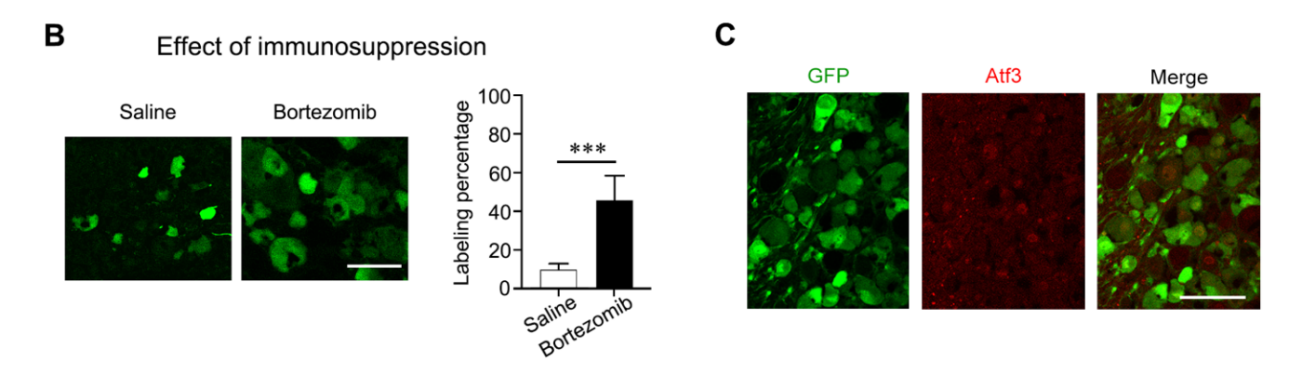
6-7 days post-surgery, about 50% of neurons in L5 DRG were EYFP-labeled, including both small- and large-diameter neurons. The number of labeled cells was five times greater than in the control group, which received saline treatment after virus injection. The expression of the peripheral nerve injury gene marker, activated transcription factor 3 (Atf3), was detected, excluding mice with significant nerve damage in the DRG.
Conclusion:
By injecting a small amount of HSV virus into the L5 DRG of mice and immediately administering an immunosuppressant injection, the infection of HSV in the DRG neurons of mice is effectively enhanced.
Contact Us:
Brain Case provides the above viral products/services. We also offer customized components upon request! Contact us at bd@ebraincase.com for more details.
Service Type :
Select the service you'd like to purchase.
Order Information(Premade-AAVs)
Please provide us some information about the service you'd like to order.
Order Information(Custom AAV/Lentivirus)
Please provide us some information about the service you'd like to order.
Order Information(Others)
Please provide us some information about the service you'd like to order.