Distinguishing ssAAV and scAAV in One Article: Avoid Pitfalls in AAV Vector Selection
Release time:2026-06-30 17:28:24
I. Definitions and Applications
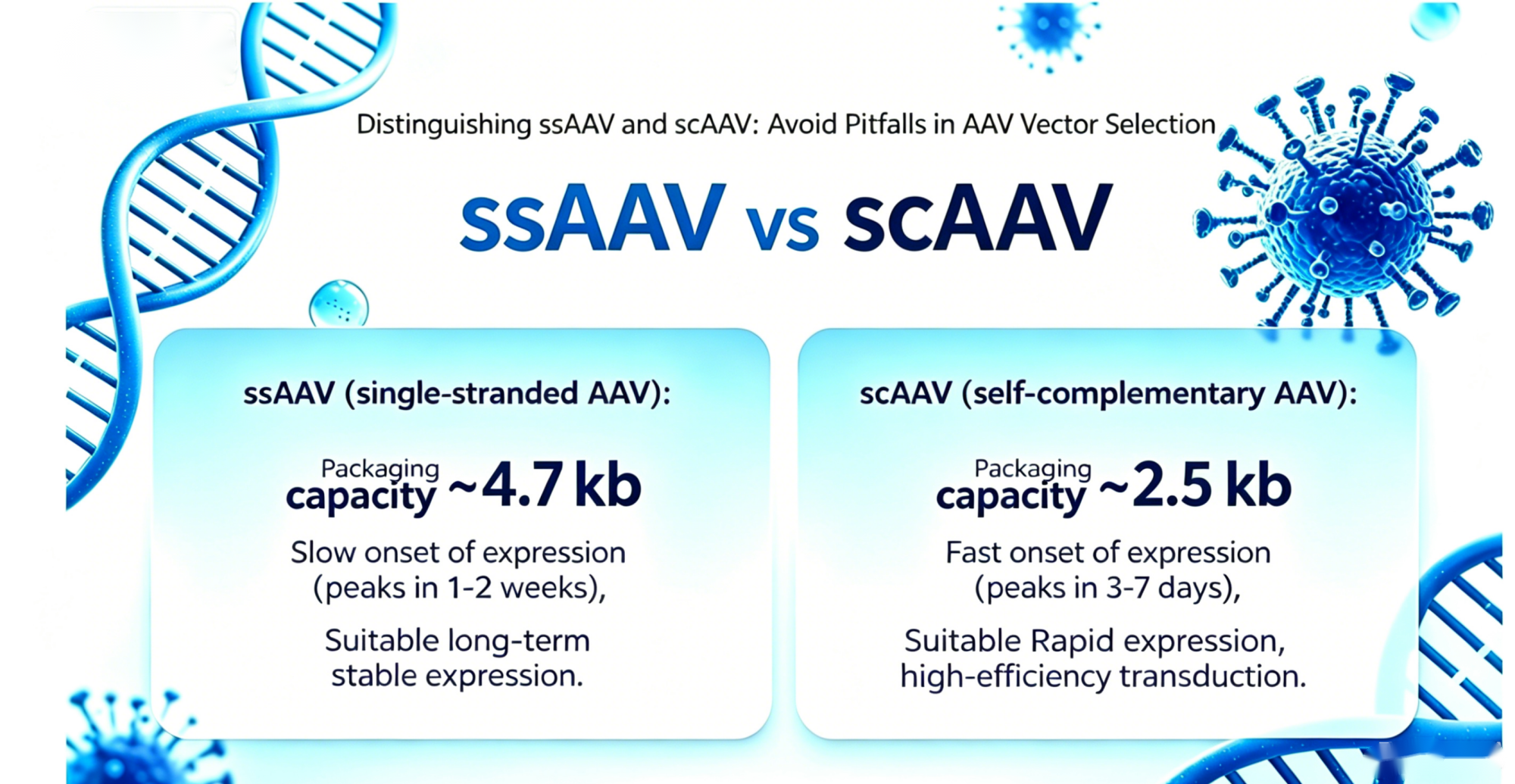
ssAAV (single-stranded AAV):
The genome is single-stranded DNA. After entering the cell nucleus, it must wait for the host cell to synthesize a complementary strand before transcription can begin.
Structure: The natural wild-type form of AAV. Its genome is single-stranded linear DNA flanked by intact wild-type ITRs (inverted terminal repeats).
Applications: In vivo and in vitro gene delivery, long-term stable expression, and studies or therapies requiring larger gene payloads.
scAAV (self-complementary AAV):
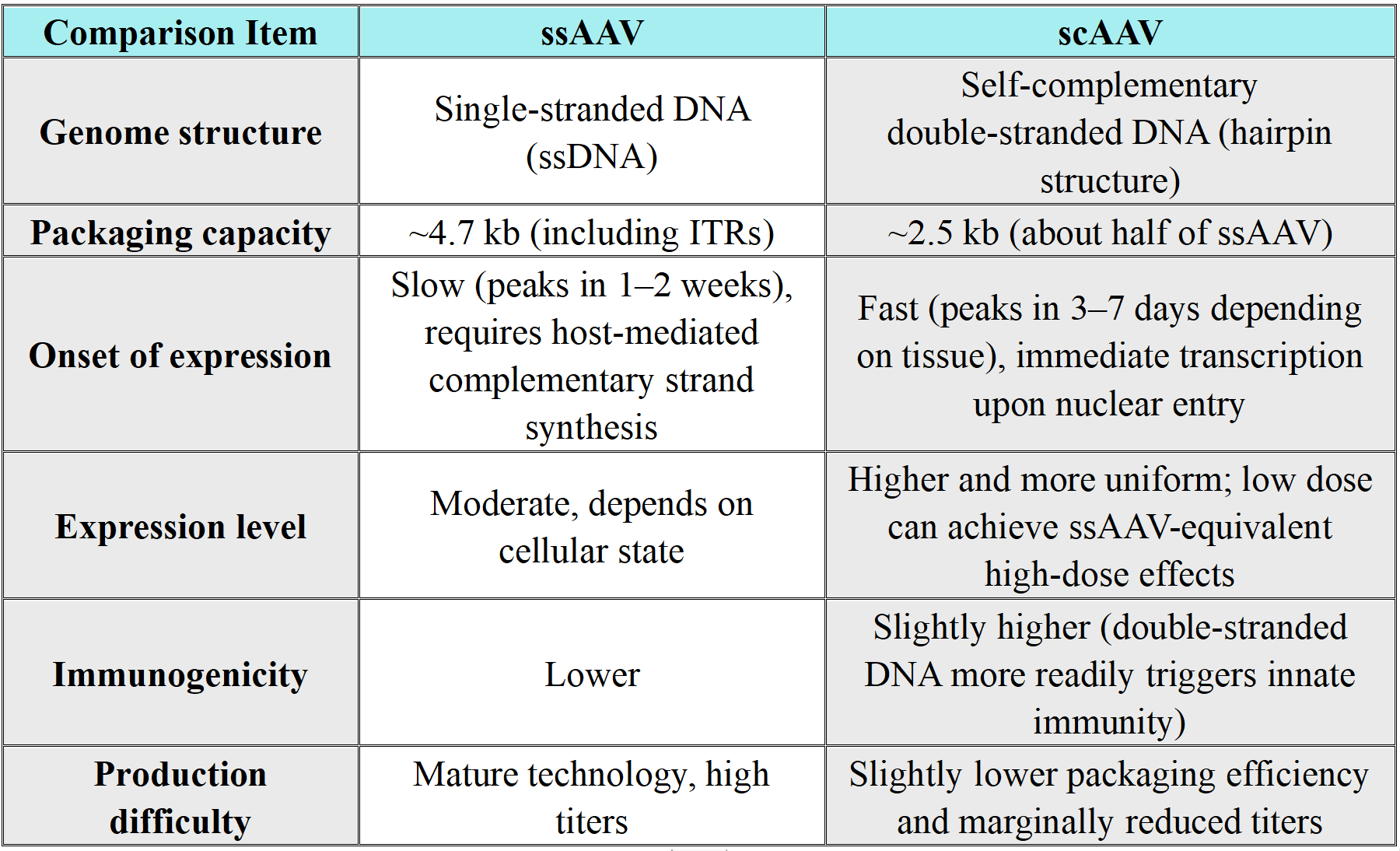
The genome forms a self-complementary double-stranded hairpin structure mediated by terminal ITRs. Once inside the nucleus, it can be directly transcribed as double-stranded DNA, bypassing the rate-limiting step of second-strand synthesis. Structure: Engineered by mutating or deleting one ITR, resulting in a self-complementary double-stranded DNA genome with a hairpin configuration that does not require host-mediated complementary strand synthesis. Applications: Rapid expression, high-efficiency transduction, gene editing/RNA interference (sgRNA, miRNA, shRNA), and treatment of acute diseases.
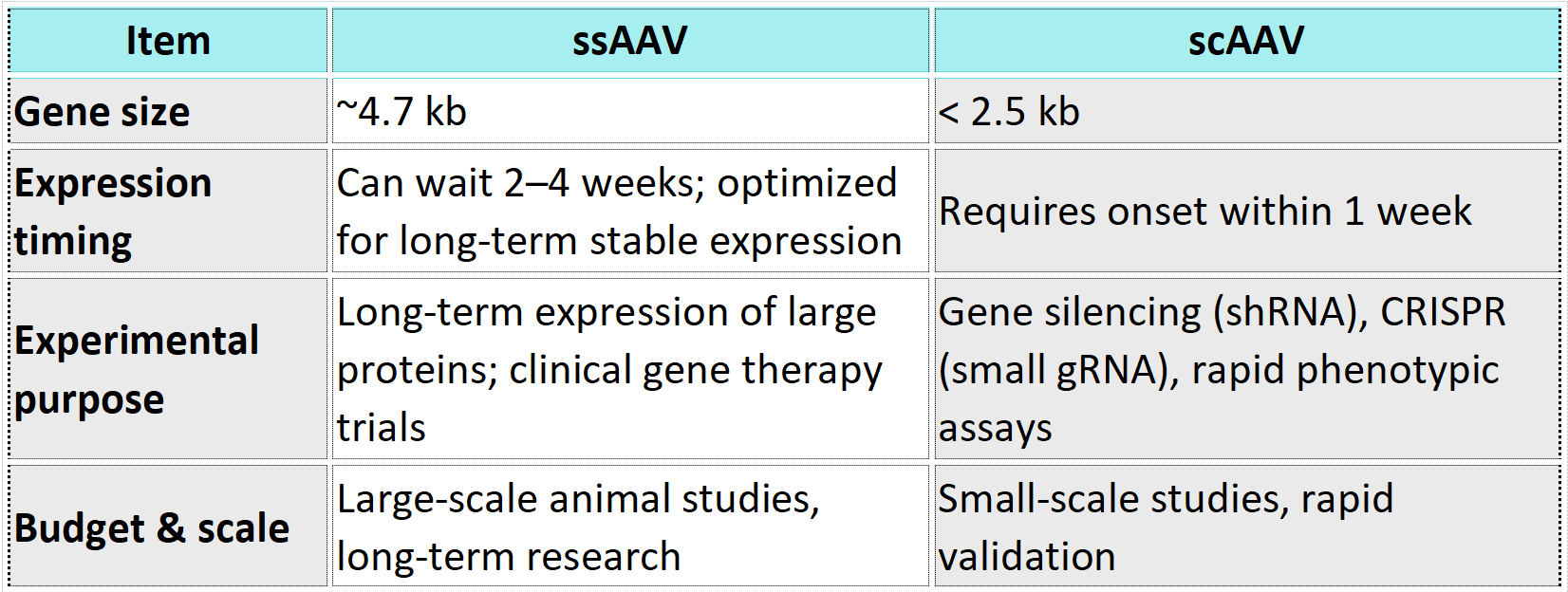
II. Key Differences
III. scAAV Application Cases
Case 1: Gene Editing
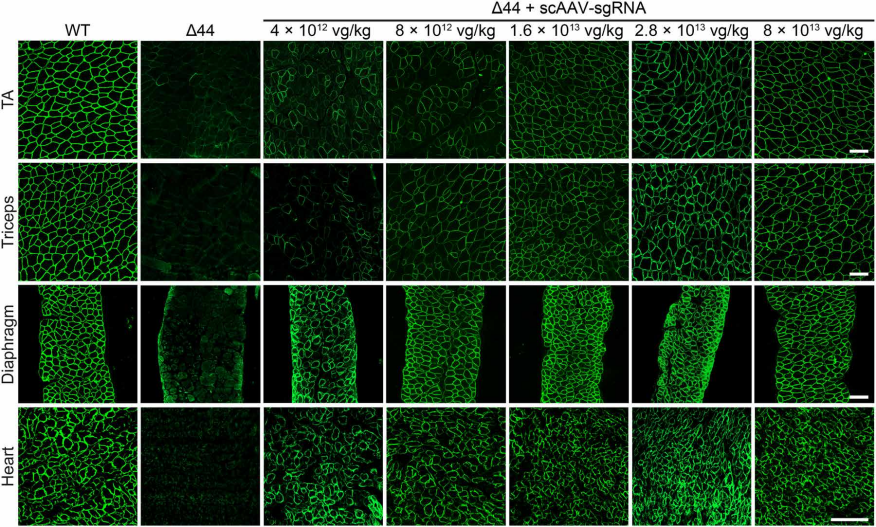
Using AAV9 as the vector, a muscle-specific promoter was used to drive SpCas9 expression. In ΔEx44 mice (DMD model with exon 44 deletion), intraperitoneal injection of ssAAV-SpCas9 was administered at a dose of 8 × 10¹³ vg/kg, followed by gradient dosing of scAAV-sgRNA targeting the exon 45 splice acceptor region. Four weeks after administration, immunohistochemistry showed a dose-dependent restoration of dystrophin expression. Even the lowest dose of scAAV-sgRNA (4 × 10¹² vg/kg) achieved ~40% and ~32% positive muscle fibers in tibialis anterior and triceps muscles, respectively, while diaphragm and cardiac muscle reached up to 95%. These results demonstrate that low-dose scAAV-mediated sgRNA delivery is highly efficient and can effectively restore dystrophin expression.
Figure 1. Systemic delivery of scAAV-packaged sgRNA efficiently restores dystrophin expression in ΔEx44 mice
Case 2: miRNA Regulation
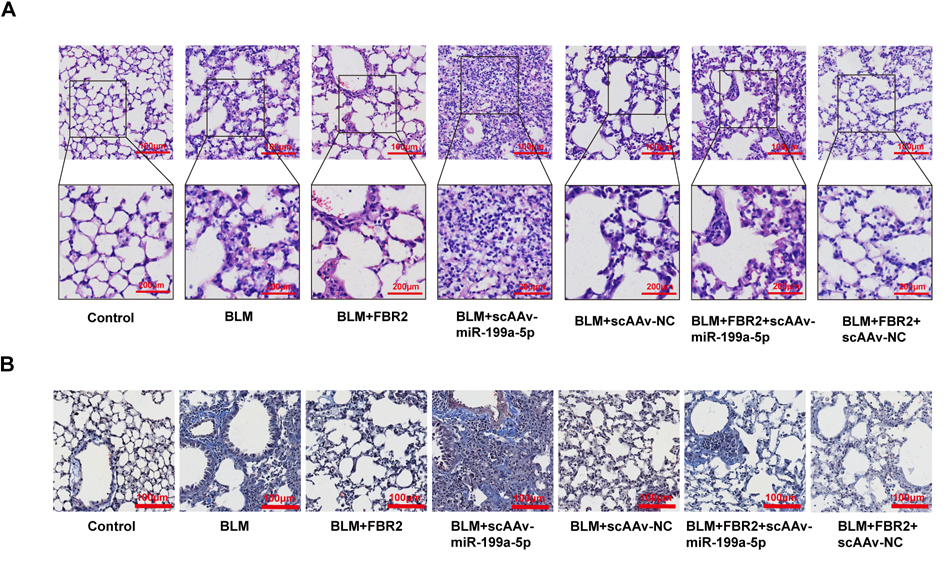
Hematoxylin and eosin (H&E) staining and Masson’s trichrome staining showed that in the bleomycin (BL) group, lung tissue exhibited severe structural disruption, thickened alveolar walls, and marked fibrosis. Intervention with FBR2 (a traditional Chinese medicine formula for pulmonary fibrosis) alleviated pathological damage and reduced Ashcroft fibrosis scores, collagen deposition, and inflammatory levels. However, tracheal instillation of 50 μL scAAV-CMV-ZsGreen1-miR-199a-5p (5 × 10¹⁰ vg), which drives overexpression of the profibrotic microRNA miR-199a-5p, reversed the protective effects of FBR2. After 4 weeks, protein analysis showed that FBR2 downregulated α-SMA and type III collagen while upregulating E-cadherin; overexpression of miR-199a-5p weakened these regulatory effects.
Figure 2. FBR2 improves bleomycin-induced pulmonary fibrosis in mice by suppressing miR-199a-5p and regulating fibrosis-related proteins
Case 3: Target Gene Overexpression
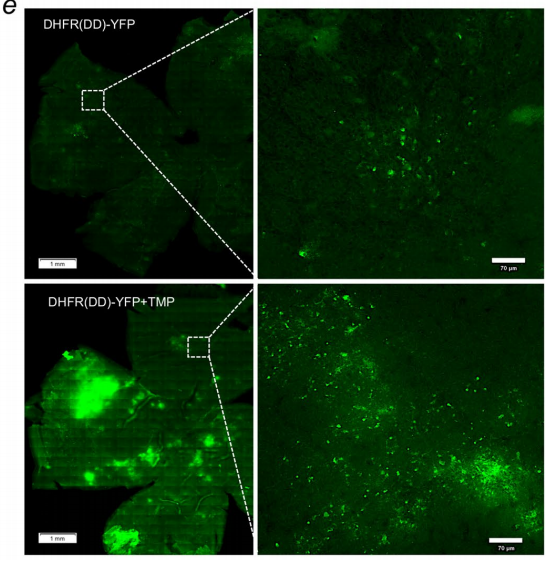
To validate scAAV2-mediated gene delivery and expression controlled by the DHFR(DD) destabilization domain, 1 μL of scAAV2-DHFR(DD)-YFP virus (2–2.5 × 10⁹ vg) was injected into the vitreous of postnatal day 7 OIR (oxygen-induced retinopathy) rats. Eleven days later, results showed efficient transduction across all retinal layers and glial cells. The DHFR(DD)-YFP fusion protein exhibited dose-dependent stabilization in the presence of trimethoprim (TMP). qPCR and Western blot analyses confirmed that TMP did not affect mRNA levels but instead regulated protein stability at the post-translational level, enabling controllable expression. These findings demonstrate that scAAV2 efficiently delivers DHFR(DD) constructs, and TMP effectively stabilizes protein expression.
Figure 3. Validation of DHFR(DD)-based transgene regulation in the rat retina
Related Posts
Heart Series | Applications of AAV in Gene Therapy: Serotype Selection, Promoter Choice, and Injection Strategies
Liver Series | Applications of AAV in Gene Therapy: Serotype Selection, Promoter Choice, and Injection Strategies
Muscle Series | Applications of AAV in Gene Therapy: Serotype Selection, Promoter Choice, and Injection Strategies
Pancreas Series | Applications of AAV in Gene Therapy: Serotype Selection, Promoter Choice, and Injection Strategies
Eye Series | Applications of AAV in Gene Therapy: Serotype Selection, Promoter Choice, and Injection Strategies
Kidney Series | Applications of AAV in Gene Therapy: Serotype Selection, Promoter Choice, and Injection Strategies
ssAAV = large capacity + slow onset + long-term stability, suitable for large genes and long-term therapeutic applications. scAAV = small capacity + fast onset + high efficiency and uniform expression, suitable for rapid expression, gene editing, and acute disease models.
Brain Case continues to share the latest developments and applications in gene and cell therapy. To learn more, please visit www.ebraincase.com. For any inquiries about our services or products, please contact bd@ebraincase.com.
References
1、McCarty DM. Self-complementary AAV vectors; advances and applications. Mol Ther. 2008;16(10):1648-1656. 2、Zhang Y, Li H, Min YL, et al. Enhanced CRISPR-Cas9 correction of Duchenne muscular dystrophy in mice by a self-complementary AAV delivery system. Sci Adv. 2020;6(8):eaay6812. 3、Li Z, Liu Z, Wei W, Niu J, Wu J, Jiao Y. Improvement of Number 2 Feibi Recipe on pulmonary fibrosis in mice by inhibiting the level of miR-199a-5p and activating autophagy. Sci Rep. 2025;15(1):44020. 4、Chen J, Lin FL, Leung JYK, et al. A drug-tunable Flt23k gene therapy for controlled intervention in retinal neovascularization. Angiogenesis. 2021;24(1):97-110.
Service Type :
Select the service you'd like to purchase.
Order Information(Premade-AAVs)
Please provide us some information about the service you'd like to order.
Order Information(Custom AAV/Lentivirus)
Please provide us some information about the service you'd like to order.
Order Information(Others)
Please provide us some information about the service you'd like to order.