“Tool viruses” generally refer to viral vectors that have been artificially engineered for gene delivery or functional regulation (such as AAV, lentivirus, adenovirus, etc.). Their core purpose is to achieve precise, safe, efficient delivery and long-term expression of exogenous genes. They are essential tools in fields such as neuroscience and gene therapy. Viruses have a relatively simple structural organization, consisting of a basic structure (an internal genome and an outer protein capsid) and, in some cases, accessory structures such as a lipid envelope and surface spike proteins. Overall, they are extremely simple in architecture, typically ranging from 20–260 nm in size and observable only under an electron microscope. Their structure is so minimal that it is even difficult to determine whether viruses should be classified as living organisms. However, despite their simplicity and microscopic scale, viruses exert an influence far beyond their size—not limited to causing disease. Viruses survive by hijacking the biological systems of host cells. Once inside a cell, they deliver their viral genome as a “payload,” after which the host cellular machinery is exploited to replicate the viral genome and produce viral proteins. For molecular biologists engaged in exploratory research, this property is of great practical value.
Viral structure
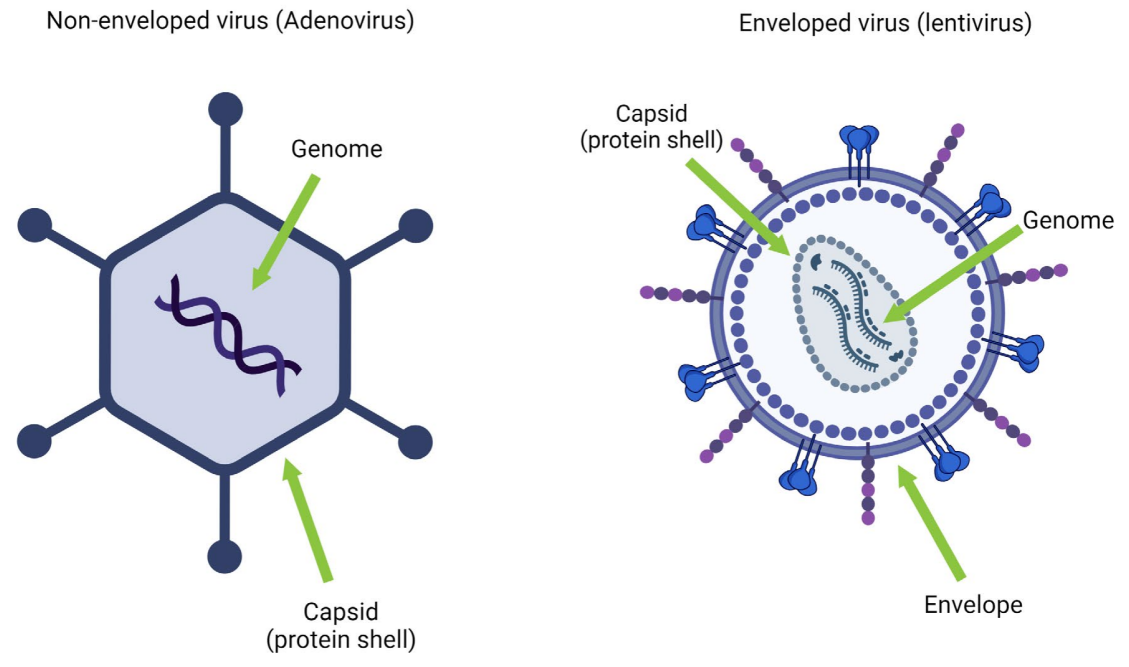
The genome of all viruses is enclosed within a protein shell called the capsid. In some viruses, this capsid is further surrounded by a lipid bilayer membrane known as the envelope. Viruses without an envelope are referred to as naked or non-enveloped viruses, whereas those with an envelope are called enveloped viruses (Fig. 1).
Fig. 1 Non-enveloped viruses (left) vs. enveloped viruses (right)
Viral genomes and replication
In terms of replication strategies, viruses can be described as “each doing things their own way.” Their genome types are highly diverse and may be double-stranded (ds) or single-stranded (ss), including: double-stranded DNA (dsDNA), single-stranded DNA (ssDNA), double-stranded RNA (dsRNA), positive-sense single-stranded RNA (+ssRNA), and negative-sense single-stranded RNA (-ssRNA). Correspondingly, their replication mechanisms also vary significantly.
DNA genome viruses:
These either follow the central dogma (genomic DNA → mRNA → protein) to complete replication, or require a DNA replication intermediate between DNA and mRNA. Depending on the virus, replication of DNA genomes may involve RNA intermediates or double-stranded DNA intermediates.
RNA genome viruses:
These may be directly transcribed into mRNA or translated into proteins. For retroviruses, the RNA genome is first reverse-transcribed into DNA, which is then transcribed into mRNA and subsequently translated into protein. Depending on their classification, RNA viruses utilize different RNA or DNA intermediates to complete genome replication.
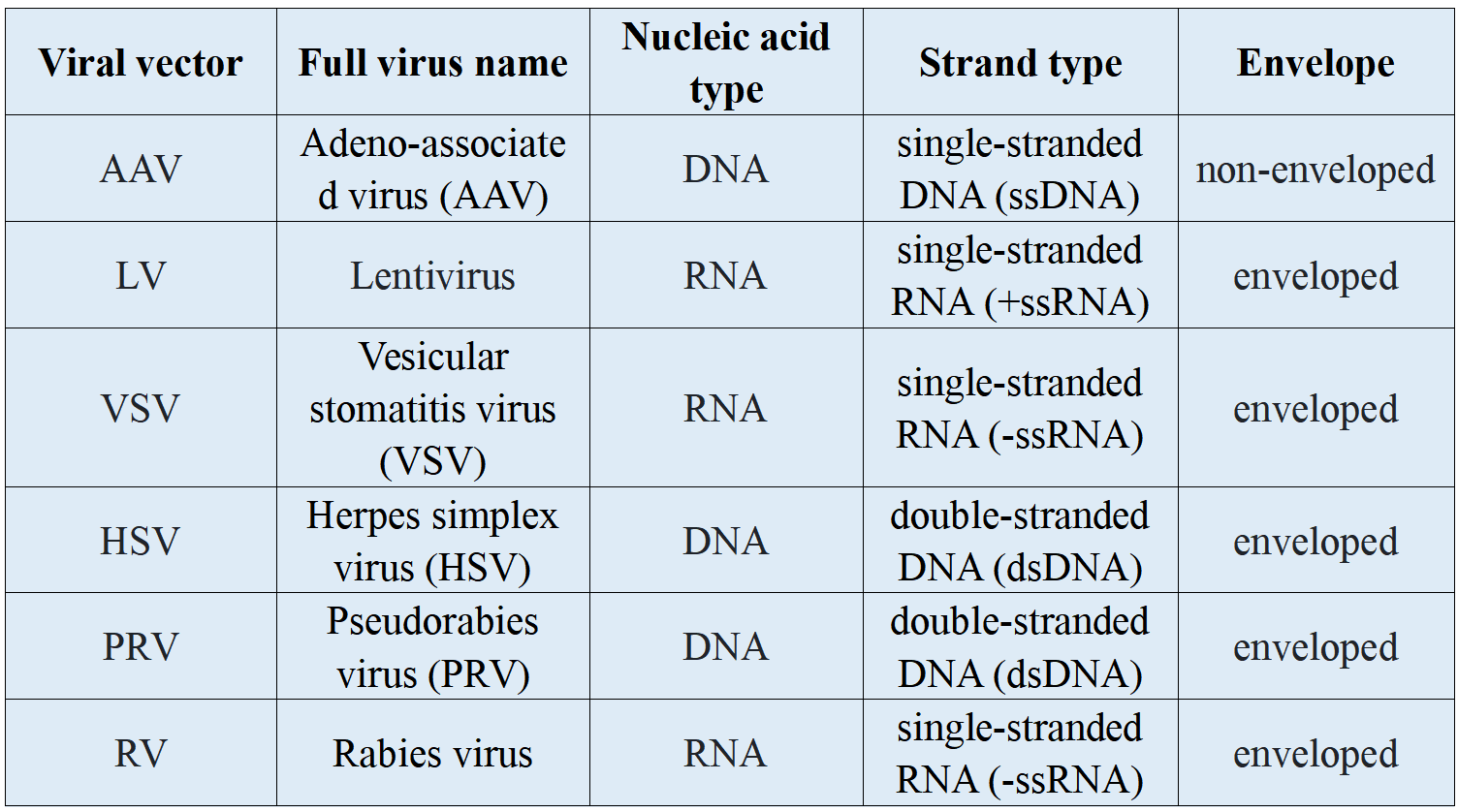
For ease of distinction and application in research, the key characteristics of commonly used viral vectors are summarized in the table below:
Viral vectors
If infection risk is not considered, viruses are highly attractive as molecular biology tools. Fortunately, through genetic engineering—modifying viruses to eliminate or reduce their infectivity—researchers have developed viral vectors with greatly improved safety profiles that can be handled in BSL-1 or BSL-2 laboratories. Viral vectors are viruses that have been genetically engineered so that their replication capacity is significantly weakened or completely abolished. After modification, they retain the protein capsid (and envelope, if present), but their genomes are streamlined and essential replication genes are removed. As a result, they cannot produce new infectious viral particles. This core principle is most clearly exemplified by AAV and lentiviral vectors.
1. Adeno-associated virus (AAV) vectors
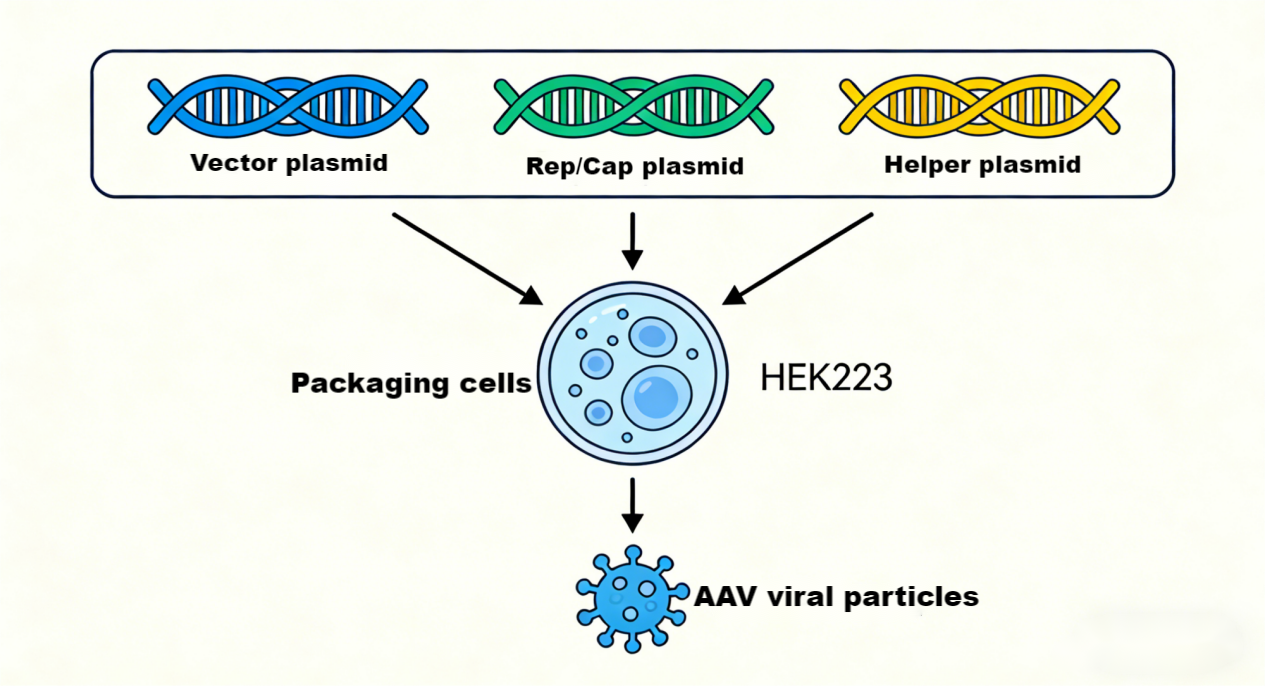
In natural AAV, the essential replication genes are rep (responsible for replication) and cap (encoding capsid proteins). During engineering, these genes are removed, leaving only the inverted terminal repeat (ITR) sequences, which serve as signals for transgene integration and replication. The gene of interest is then inserted. Because engineered AAV lacks replication-essential genes, it cannot replicate or package itself autonomously. It can only be assembled into complete viral particles in the laboratory in the presence of helper plasmids. Once produced, it serves solely as a gene delivery vehicle and cannot generate new infectious particles. At the same time, engineering improves its packaging capacity: the natural AAV genome is approximately 4.7 kb, and the modified system can carry around 4.3 kb of foreign DNA, meeting the needs of most research and clinical applications. In some cases, split-vector strategies can further expand its cargo capacity.
Fig. 2 AAV triple-plasmid packaging system
2. Lentiviral vectors
In natural lentiviruses, the essential replication genes include gag (encoding structural core proteins), pol (encoding reverse transcriptase and integrase), env (encoding envelope proteins), and rev (responsible for nuclear export of viral RNA). During engineering, all of these genes are removed, leaving only LTR sequences and packaging signals, into which the gene of interest is inserted. Engineered lentiviral vectors retain the envelope protein (commonly VSV-G, which broadens the host range) and must be co-transfected into packaging cells together with helper plasmids carrying the essential replication genes in order to assemble into complete viral particles. This design ensures both safety (only gene delivery without spread) and relatively large cargo capacity (increased from ~9.7 kb in wild-type viruses to ~8 kb for transgenes). Lentiviral vectors are widely used in cell engineering, CAR-T therapy, and other applications.
Fig. 3 Lentiviral triple-plasmid packaging system
The four most commonly used viral vectors (which many researchers, even when referring to “viral vectors,” simply call “viruses”) are named after their source viruses: adeno-associated virus (AAV), lentivirus, γ-retrovirus, and adenovirus. With this foundation, we can now explore their specific applications in greater depth.
What are “tool viruses” actually used for?
Tool viruses are not just “small tools” in the lab—they have become an indispensable core force in modern life sciences, medical research, and clinical therapy, underpinning many of the major breakthroughs in genetics and cell biology over the past decade.
1. Gene therapy: “patching” defective genes
Many genetic and rare diseases are caused by faulty genes. Tool viruses act like precision delivery couriers, transporting functional genes into cells to replace defective ones and restore normal biological function. At present, diseases such as hemophilia, spinal muscular atrophy (SMA), and congenital blindness have been successfully treated using AAV-based single-dose, long-term therapeutic approaches.
2. Cell therapy: reprogramming immune cells to fight cancer
The most representative example is CAR-T cell therapy. Lentiviruses are used to deliver “anti-cancer navigation genes” into a patient’s T cells, equipping immune cells with a targeting system that allows them to precisely recognize and eliminate cancer cells. Tool viruses are the key gene delivery vehicles in the entire cell therapy workflow.
3. Neuroscience research: illuminating the brain and decoding behavior
Brain circuits are highly complex and difficult to map. Tool viruses enable precise labeling and manipulation of specific neuronal populations. Researchers use them for neural tracing, optogenetics, chemogenetics, and calcium imaging to study mechanisms underlying memory, emotion, movement, feeding, and sleep—helping us understand how the brain truly works.
4. Disease model construction: rapidly generating research systems
To study a disease, researchers no longer need to wait for time-consuming transgenic animal generation. Instead, tool viruses can be used to deliver relevant genes directly, enabling fast and cost-effective construction of disease models in mice or rats, greatly accelerating drug screening and mechanistic studies.
5. Basic research: a “universal toolkit” for gene function
To understand what a gene does, researchers can use tool viruses to deliver it into cells, knock it down/out, or overexpress it, and then observe cellular changes. This is one of the most widely used and efficient approaches for studying gene function, signaling pathways, and protein interactions.
6. Vaccine development: safe and efficient antigen delivery
Engineered viral vectors can carry antigen genes from pathogens. While non-pathogenic themselves, they can still elicit strong immune responses. They are widely used in the development of infectious disease vaccines and cancer vaccines, offering fast response, high safety, and durable protection.
At the same time, Brain Case also provides a wide range of customized services. For more information, please contact bd@ebraincase.com.
Service Type :
Select the service you'd like to purchase.
Order Information(Premade-AAVs)
Please provide us some information about the service you'd like to order.
Order Information(Custom AAV/Lentivirus)
Please provide us some information about the service you'd like to order.
Order Information(Others)
Please provide us some information about the service you'd like to order.