A Novel Serotype for Peripheral Retrograde Tracing — AAV9-Retro
Time:2026-07-08 11:36:23
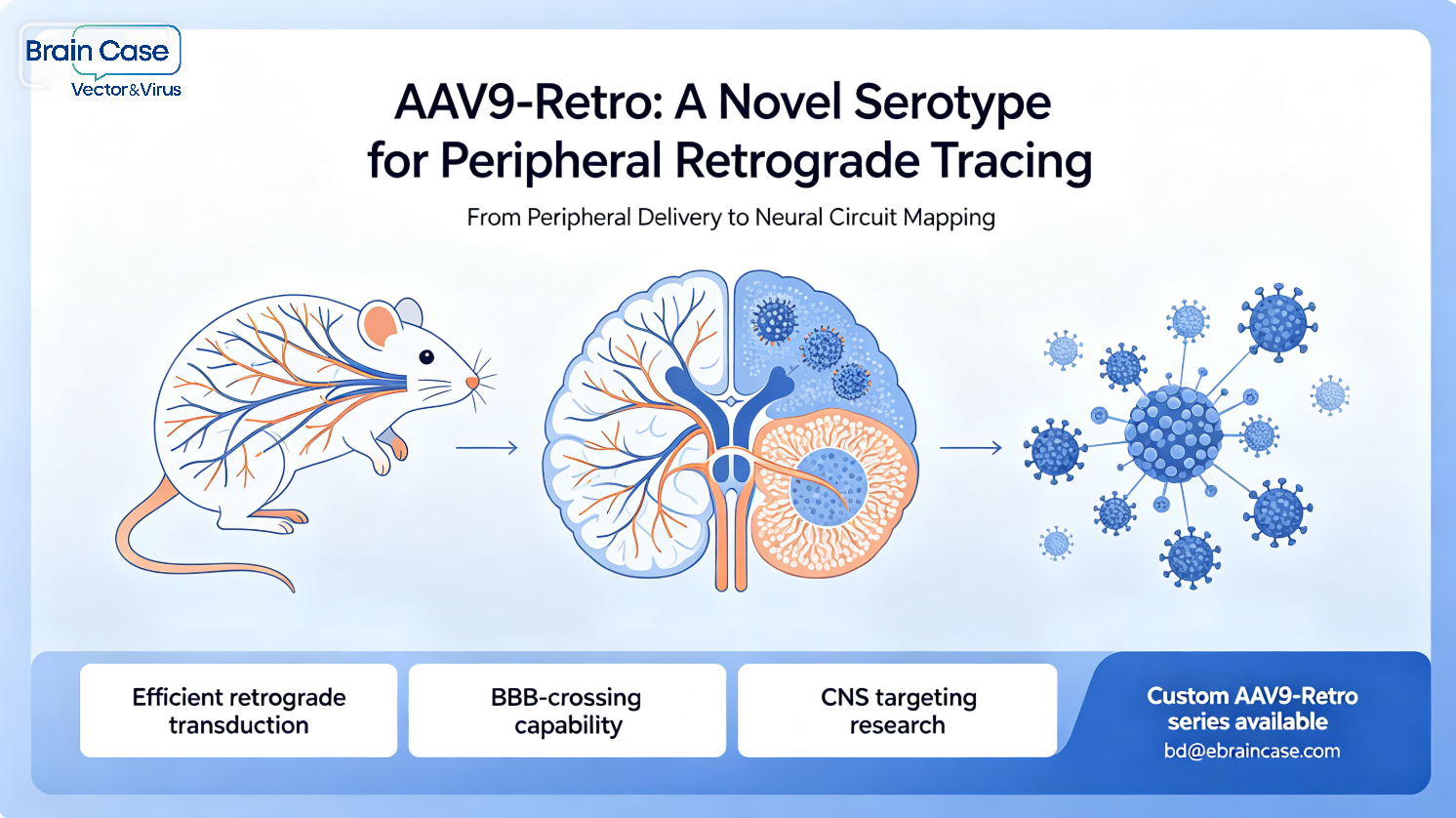
Adeno-associated viruses (AAVs) capable of highly efficient retrograde transport or efficient neuronal transduction across the blood-brain barrier (BBB) are among the most powerful viral vector tools for studying the structure and function of neural circuits and developing therapeutic strategies for brain diseases. However, no AAV serotype possessing both of these key characteristics had been reported previously. On October 14, 2020, the team led by Fuqiang Xu at the Shenzhen Institute of Advanced Technology, Chinese Academy of Sciences published a study entitled “AAV9-Retro mediates efficient transduction with axon terminal absorption and blood-brain barrier transportation” in Molecular Brain. In this study, the researchers engineered the capsid protein of AAV9 and developed a novel AAV serotype, AAV9-Retro.
AAV9-Retro retains the ability of AAV9 to cross the blood-brain barrier while exhibiting retrograde neuronal transduction efficiency comparable to AAV2-Retro. This provides new approaches for systemic delivery to the central nervous system (CNS) and offers a powerful new tool for neural circuit mapping as well as preclinical and clinical research on neurodegenerative disease therapies.
Compared with other AAV serotypes, AAV2-Retro, developed through directed evolution, exhibits superior retrograde transduction efficiency and has become an important viral tool for retrograde tracing in neural circuit analysis. In this study, based on the distinct targeting properties of different viral capsids, researchers applied an advantageous combination strategy by inserting the 10-mer peptide sequence (LADQDYTKTA) from AAV2-Retro into the capsid of AAV9, generating the novel serotype AAV9-Retro.
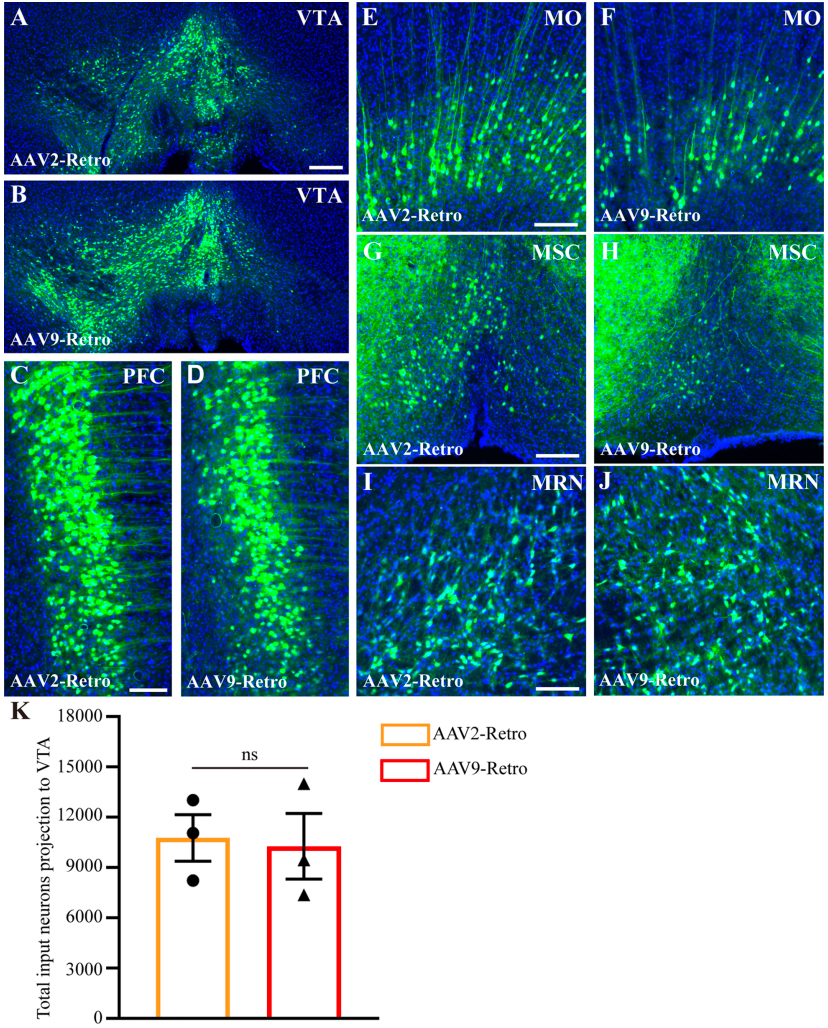
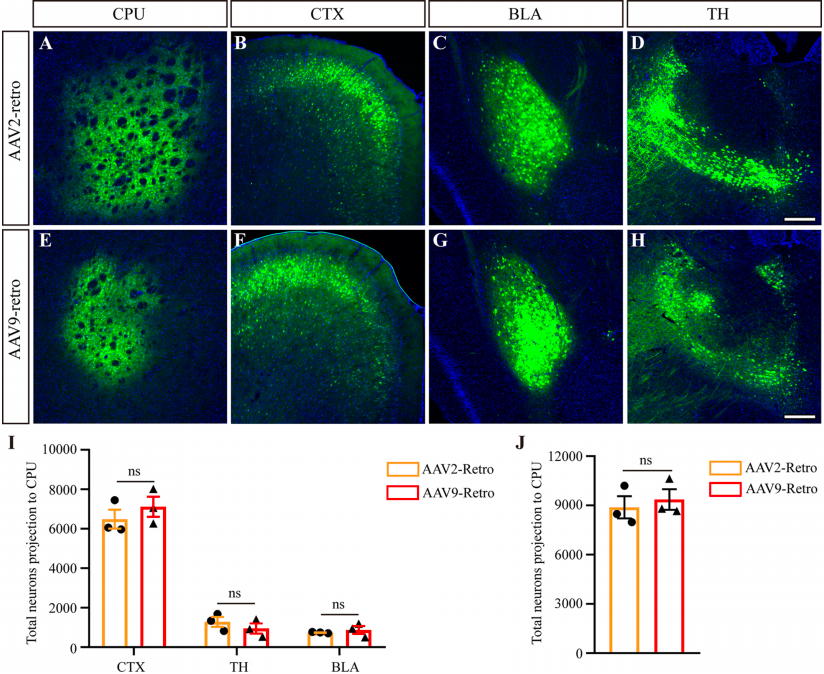
Following injection of rAAV9-Retro-CaMKIIα-EGFP into the mouse VTA region, abundant fluorescence signals were detected in upstream brain regions 21 days after injection. Further comparison with AAV2-Retro demonstrated that both serotypes could transduce the same brain regions (VTA and CPU) and their upstream projection areas, with comparable retrograde infection efficiency (Figures 1 and 2).
Figure 1. rAAV9-Retro and rAAV2-Retro injection into the VTA (top)
Figure 2. Comparison of transduction efficiency in the CPU region (bottom)
In addition to exhibiting retrograde transduction efficiency comparable to AAV2-Retro, AAV9-Retro also retains the BBB-crossing capability of AAV9. After intravenous injection of AAV9-Retro-EGFP into adult mice via the tail vein, fluorescence signals were detected in key brain regions, including the cortex, striatum, globus pallidus, hippocampus, thalamus, and hypothalamus. The transduction efficiency was comparable to that of the AAV9 serotype.
Therefore, AAV9-Retro represents a promising tool for peripheral gene delivery and ascending neural circuit labeling, providing expanded possibilities for systemic CNS targeting, neural circuit research, and gene therapy applications.
Application Example of the AAV9-Retro Serotype
On May 10, 2024, the research team led by Zhigang He at Boston Children’s Hospital, Harvard Medical School published a study entitled “Spinal projecting neurons in rostral ventromedial medulla co-regulate motor and sympathetic tone” in Cell. This study revealed that spinal projecting neurons located in the rostral ventromedial medulla (rVMM) of the brainstem simultaneously regulate somatic motor control and sympathetic nervous system activity.
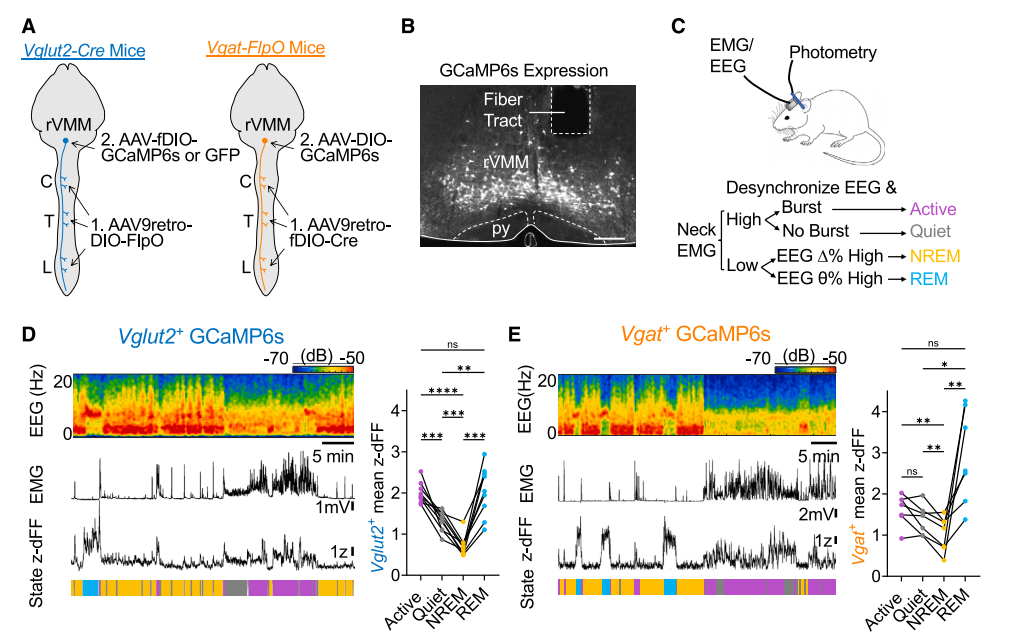
In this study, the researchers utilized the AAV9-Retro serotype, which exhibits efficient retrograde labeling capability, as a viral vector tool. By employing a Cre/Flp-LoxP recombinase-based strategy, they injected AAV-EGFP into the spinal cord to label spinal projecting neurons in the mouse brain (Figure 3).
Furthermore, the team combined approaches including optogenetics and calcium imaging to activate excitatory or inhibitory spinal projecting neurons in anesthetized mice. They found that excitatory spinal projecting neurons in the rVMM simultaneously induced skeletal muscle contraction and sympathetic responses, including changes in blood pressure and heart rate. In contrast, inhibitory spinal projecting neurons within the same brain region simultaneously suppressed both skeletal muscle contraction and sympathetic responses.
Figure 3. Activity patterns of excitatory and inhibitory rVMM spinal projecting neurons (rVMMspn) under different behavioral states
The AAV9-Retro series products from Brain Case Biotech are now available! This product not only exhibits retrograde transduction efficiency comparable to AAV2-Retro but also retains the advantage of AAV9-mediated blood-brain barrier (BBB) crossing, making it a powerful tool for investigating the structure and function of neural circuits.
Meanwhile, the AAV9-Retro series can be customized according to your specific experimental requirements. If you are interested in AAV9-Retro products, please contact bd@ebraincase.com for more information or to place an order.
Service Type :
Select the service you'd like to purchase.
Order Information(Premade-AAVs)
Please provide us some information about the service you'd like to order.
Order Information(Custom AAV/Lentivirus)
Please provide us some information about the service you'd like to order.
Order Information(Others)
Please provide us some information about the service you'd like to order.