- E-mail:BD@ebraincase.com
- Tel:+8618971215294


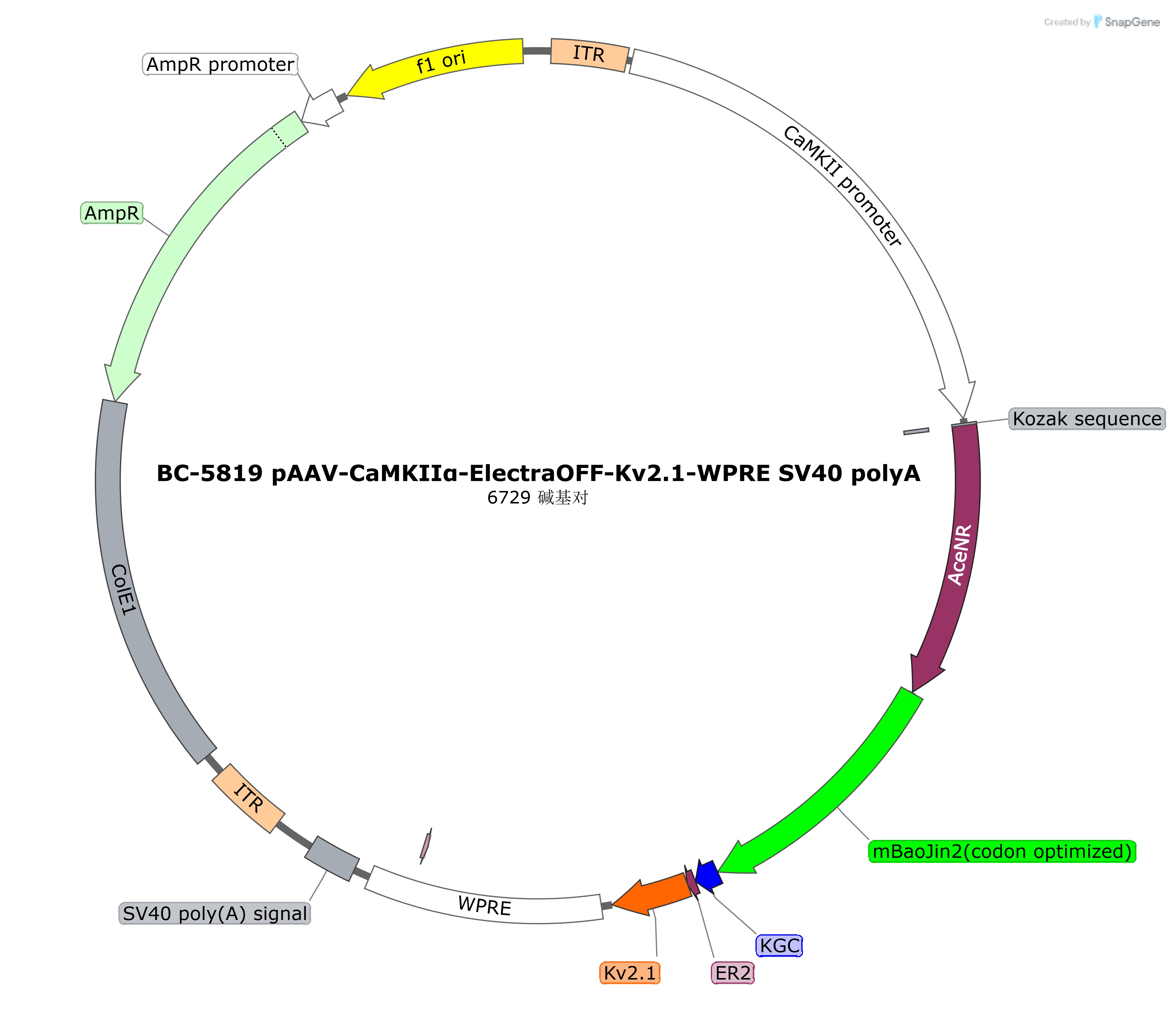
Features:
ElectraOFF: Highly photostable negative-going green fluorescent voltage indicator for ultra-long neuronal recordings.
Gene/Insert name:ElectraOFF-Kv2.1
Tag/Fusion protein:ElectraOFF
Titer:>1x10^13 VG/mL,>5x10^12 VG/mL
Volume:100μL
For a clearer view, right-click the image and open it in a new tab.
Click to Explore More ElectraOFF AAV Options
Brain Case is honored to have received authorization from Professor Kiryl Piatkevich' s laboratory to produce various tool vectors. For inquiries, please contact Prof. Piatkevich' s laboratory (kiryl.piatkevich@westlake.edu.cn and zhoushihao@westlake.edu.cn), or reach out to Brain Case at BD@ebraincase.com.
Usually Ships in 7 Business Days
Key Performance:
1) Negative polarity (fluorescence decreases with depolarization);
2) >6-fold improved photostability compared to state-of-the-art eFRET GEVIs (pAce, Ace-mNeon2) under one-photon illumination;
3) 14.5% ΔF/F per action potential with SNR of ~9.20 in cultured neurons (comparable to Ace-mNeon2);
4) ~1.6-fold brighter than Ace-mNeon2 in mammalian cells;
5) Fast kinetics (τ_on = 1.75 ± 0.32 ms; τ_off = 1.14 ± 0.25 ms);
6) 3-to >10-fold extension in functional recording duration for spike detection;
7) Exceptionally slow SNR decay (only 13% loss over 30 minutes at 5 mW/mm²);
8) Ultra-stable in vivo – routinely >30 minutes, occasionally up to 80+ minutes in behaving mice;
9) 4.6-fold slower SNR decrease compared to Ace-mNeon2 in vivo;
10) Functional under scanless two-photon excitation (~18% ΔF/F with SNR 5-10).
Applications:
1) Ultra-long voltage imaging in behaving mammals (30-80+ minutes continuous trials);
2) Extended in vivo recordings across multiple neuron types (pyramidal neurons, PV+ interneurons, VIP+ interneurons, cholinergic interneurons);
3) Multi-region voltage imaging (hippocampus CA1, visual cortex, striatum);
4) Long-term synaptic plasticity studies and circuit dynamics during behavior;
5) Intracranial electrical stimulation studies and neuromodulation research;
6) Trial-based sensory adaptation and skill learning experiments;
7) Widefield population voltage imaging with minimal photobleaching;
8) Two-photon voltage imaging in deep brain tissues;
9) Chronic neuronal activity monitoring in disease models.
Please provide us some information about the service you'd like to order.
( Select the service you'd like to purchase. )


WhatsApp Business Account
Address:-
Address:-